-
![Plastic Ceiling Panel]() Plastic Ceiling PanelPlastic ceiling panels have become the definitive solution for tackling one of the most persistent headaches in home renovation: the damp, mold-prone bathroom ceiling. In spaces where steam from hot
Plastic Ceiling PanelPlastic ceiling panels have become the definitive solution for tackling one of the most persistent headaches in home renovation: the damp, mold-prone bathroom ceiling. In spaces where steam from hot -
![White PVC Ceiling Panel]() White PVC Ceiling PanelWhite PVC ceiling panels have become the go-to choice for revitalizing kitchens, bathrooms, and basements where lighting is often limited and moisture is a constant threat. In older homes, ceilings
White PVC Ceiling PanelWhite PVC ceiling panels have become the go-to choice for revitalizing kitchens, bathrooms, and basements where lighting is often limited and moisture is a constant threat. In older homes, ceilings -
![PVC Wall and Ceiling Panel]() PVC Wall and Ceiling PanelChina factory PVC wall ceiling panel — dual-application hollow-core extrusion. One profile for walls and ceilings. 100–600mm widths, lengths to 5.95m. CE EN 13245-2. MOQ 500 sqm/colour. 15-35 day
PVC Wall and Ceiling PanelChina factory PVC wall ceiling panel — dual-application hollow-core extrusion. One profile for walls and ceilings. 100–600mm widths, lengths to 5.95m. CE EN 13245-2. MOQ 500 sqm/colour. 15-35 day -
![PVC Ceiling Panel Bathroom]() PVC Ceiling Panel BathroomChina factory bathroom PVC ceiling panel. 100% waterproof, B-s2,d0 fire rated. 0.2mm tolerance, virgin PVC compound. No mould substrate. Widths 100–600mm, lengths to 5.95m. CE EN 13245-2. MOQ 500
PVC Ceiling Panel BathroomChina factory bathroom PVC ceiling panel. 100% waterproof, B-s2,d0 fire rated. 0.2mm tolerance, virgin PVC compound. No mould substrate. Widths 100–600mm, lengths to 5.95m. CE EN 13245-2. MOQ 500 -
![Roof PVC Panel]() Roof PVC PanelThis product page has moved. The roof PVC panel range is now listed on our plastic ceiling panel page, with seven OEM widths, full specifications and wholesale terms. View Plastic Ceiling Panels:
Roof PVC PanelThis product page has moved. The roof PVC panel range is now listed on our plastic ceiling panel page, with seven OEM widths, full specifications and wholesale terms. View Plastic Ceiling Panels: -
![Ceiling Cladding Panel]() Ceiling Cladding PanelCeiling cladding panels have redefined how we protect and beautify overhead spaces, moving beyond simple coverage to create healthier, more elegant interiors. In modern homes, the ceiling often
Ceiling Cladding PanelCeiling cladding panels have redefined how we protect and beautify overhead spaces, moving beyond simple coverage to create healthier, more elegant interiors. In modern homes, the ceiling often


PVC Ceiling Panel — Extruded Hollow-Core Sheets for Suspended Ceilings
A PVC ceiling panel is a lightweight, hollow-core extrusion made from virgin polyvinyl chloride resin compounded with calcium carbonate, impact modifiers, and UV stabilizers. The profile runs through a twin-screw extruder, gets cooled and calibrated to ±0.2mm tolerance, then receives surface treatment — heat transfer print, thermal lamination, or cold HD transprint with a UV topcoat hardened to ≥2H pencil hardness. Fitters slot each sheet into a suspended grid of steel or aluminium furring channels. One sheet replaces what would take a plasterer three days and a painter two more. No wet trades. No drying time. Strip it, cut it, clip it in. The job gets handed over that week.
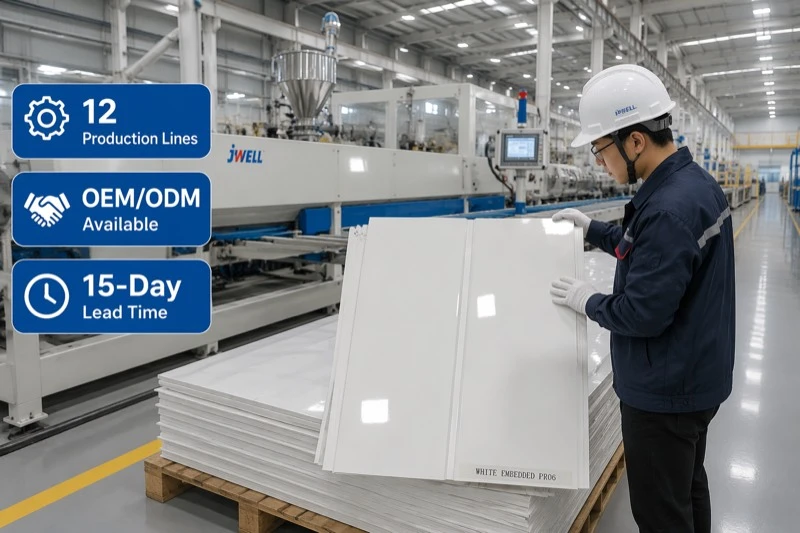
We extrude these in Haining, 140km from Ningbo port. The factory runs 36 extrusion lines. Stock moves daily — not quarterly. We supply wholesale pvc ceiling panels to distributors, contractors and wholesalers worldwide — including the UK, EU, US, Australia and New Zealand. If you are pricing a hotel fit-out across 200 rooms or a developer spec package for a new estate, you need a ceiling system that installs fast, survives site abuse, and costs less per square metre installed than gypsum board by the time you add labour.
Why Fitters Grab PVC Over Gypsum, Aluminium, and Mineral Fibre
Walk onto a wet trade site in the UK or a humidity-soaked coastal project in West Africa. Gypsum sags within 18 months if vapour barrier detailing fails. Mineral fibre tiles stain at the first AC leak. Aluminium dents under ladder impact and costs 3× more per square. None of them handle site abuse the way a PVC extrusion does.
Here is what we hear back from contractors who switched:
Water Does Nothing
100% waterproof. No swelling, no delamination, no mould food source. A plumber forgets to cap a pipe on the floor above — water pools on the ceiling overnight. Gypsum is a write-off. PVC gets wiped dry. That alone sells projects in hotel bathrooms, hospital corridors, and basement common areas.
Labour Burn Rate Drops
A two-man crew can close 40–60 m² of PVC ceiling in a day using a screw-gun and a mitre saw. Same crew on gypsum board + joint compound + sanding + primer + two topcoats: maybe 15 m² per day, across three site visits. The maths is not close. General contractors who pay by the hour see the difference on the first floor.
Weight Stays Low
A 250mm-wide, 8mm-thick hollow-core sheet weighs about 1.9–2.3 kg/m². Aluminium ceiling panels run 3–4 kg/m². Gypsum board is 6.5–8 kg/m². Lighter material means a lighter suspension grid. On a suspended ceiling 40m across, the structural steel saving adds up.
No Callbacks for Cracks
PVC is a thermoplastic. It flexes under building movement instead of cracking. Gypsum cracks at drywall joints the first winter the heating kicks in. We have products in the field in UK social housing going on 12 years with zero joint failures.
Surface Stays Clean With a Rag
The UV-cured topcoat seals the printed layer. Kitchen grease, bathroom condensation, corridor dust — one pass with a damp microfibre cloth. No repainting cycle. Facilities managers like that calculation.
PVC Ceiling Board, PVC Ceiling Sheet, PVC False Ceiling — What the Terms Actually Mean on a Purchase Order
Buyers use different words depending on which market they serve. We see the same extrusion ship to three continents under three different names. Here is how to read the PO:
PVC Ceiling Board
This term dominates African and South Asian RFQs — Zambia, Kenya, Nigeria, Bangladesh. A "PVC ceiling board" means a rigid sheet, typically 5.95m long, 200mm or 250mm wide, tongue-and-groove edge. Buyers from Lagos to Lusaka request "PVC ceiling board" because that is what the local hardware trade calls it. If your website only says "PVC ceiling panel" you are invisible to that entire supply chain. We run the same die, same compound, same tolerance — the only difference is the box label.
PVC Ceiling Sheet
Middle East and Southeast Asian wholesalers tend to use "PVC ceiling sheet" — especially when ordering in jumbo dimensions (1,220mm × 2,440mm sheets for grid ceiling systems) or specifying thickness >10mm for direct-mount applications. A "sheet" buyer is usually not working with clip-in furring channels. They are direct-screwing to timber battens or bonding to a level substrate. Different installation logic, same extrusion technology.
PVC False Ceiling / PVC Suspended Ceiling
South Asian and some UK commercial specifiers call it "PVC false ceiling." The term describes the system — a secondary ceiling hung below the structural slab, hiding MEP services and providing a clean visual plane. A PVC false ceiling uses the same panels as any other PVC ceiling application, but the spec will reference grid type (T-bar or concealed), plenum depth, and access panel requirements. India, Sri Lanka, and Gulf commercial projects write RFQs this way.
Bottom line: we manufacture one product family. The labelling changes by geography. Eastopo ships all of them from the same extrusion floor.
Technical Parameters — What the Factory Sheet Says
| Parameter | Value | Standard |
|---|---|---|
| Material | Virgin PVC resin + calcium carbonate (40-65% PVC content) | — |
| Profile structure | Hollow-core multi-chamber extrusion | — |
| Available widths | 100 / 150 / 200 / 250 / 300 / 400 / 600 mm | — |
| Available lengths | 2,700 / 3,000 / 3,600 / 5,800 / 5,950 mm (custom within 5.95m max) | — |
| Thickness | 5.0–10.0 mm (standard: 7.0–8.5 mm) | — |
| Surface weight | 1.6–3.0 kg/m² (250mm × 8mm hollow: 1.9 kg/m²) | — |
| Dimensional tolerance | Width ±0.5mm, Thickness ±0.2mm, Length ±2mm | EN 13245-2 |
| Impact resistance | No fracture at 1.0 kg / 0.5m drop, -10°C conditioned | EN 13245-2 §5.3 |
| Heat resistance (Vicat) | ≥75°C (VST/B50) | ISO 306 |
| Linear thermal expansion | ~0.06 mm/m·°C | — |
| Fire classification | B-s2,d0 or C-s2,d0 (substrate-dependent) | EN 13501-1 |
| Formaldehyde emission | E0 (≤0.5 mg/L) | EN 717-1 |
| Surface hardness | ≥2H (pencil hardness, UV topcoat) | ISO 15184 |
| Colour fastness | ≥Grade 4 (500-hour xenon arc) | ISO 105-B02 |
| Water absorption (24h) | ≤0.5% | EN 13245-2 §5.4 |
| CE certification | EN 13245-2:2008, EN 13501-1, AVCP System 4 | Certificate SC-PSC-4-2026-06-54 |
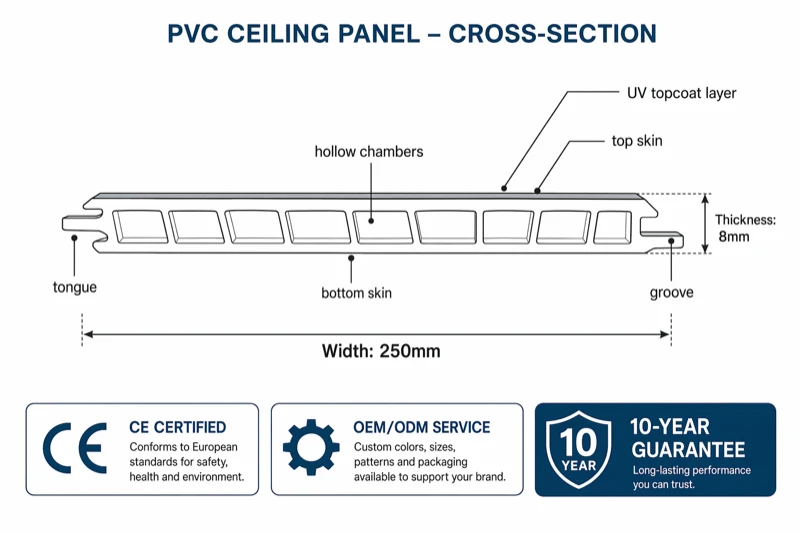
These numbers come from our in-house QC lab and third-party type testing by Certification Center LTD (Latvia, notified body). Not from a marketing deck. The 0.2mm thickness tolerance is the one that matters on site — if the tongue is 0.3mm oversize, the joint won't close clean across a 6-metre run. We reject batches above 0.2mm drift.
Surface Finish — Six Ways We Dress the Extrusion
The base profile is a white or light-grey PVC extrusion. Without surface treatment, it is a utility product — fine for storerooms and plant rooms but not for a hotel lobby. These six finish technologies turn it into an architectural surface:
| Finish | Process | Durability | Typical Spec |
|---|---|---|---|
| Heat Transfer Print | Ink sublimated into PVC surface under heat + pressure | 3–5 years UV exposure | Budget residential, rental refresh |
| Thermal Lamination | Decorative film fused to extrusion via hot-melt adhesive at 120-140°C | 8–12 years | Mid-range commercial, retail, office |
| Cold HD Transprint + UV Topcoat | HD decorative layer transferred cold, then sealed with UV-cured acrylic (≥2H) | 12–15 years | Hotels, hospitals, premium residential |
| Digital Print (on request) | UV inkjet direct-to-substrate | 5–8 years | Branded environments, custom artwork |
| Embossed (EIR) | Mechanical embossing roller syncs grain texture with print pattern | Matches base print | Wood-grain, stone-look, textured matte |
| Super Matt / Satin Feeling | Micro-textured topcoat diffuses light reflection | 10+ years | High-end residential, gallery spaces |
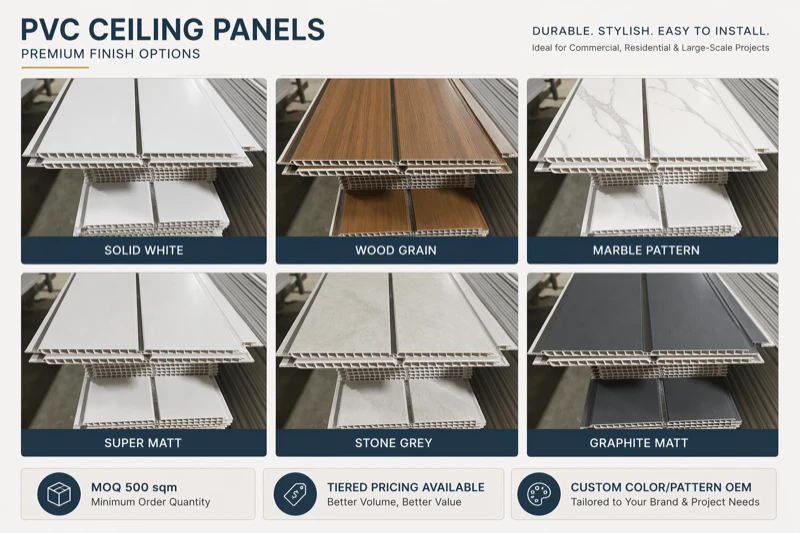
The Cold HD Transprint route is what we recommend for volume commercial work. It costs roughly 12–15% more than heat transfer print at the factory gate, but it does not delaminate in the container during a 35-day ocean crossing to Felixstowe. Heat transfer jobs that sit in a hot container for five weeks in the Gulf of Aden come off the truck with ghosting at the edges. We have learned that the hard way.
Dimensions and Loading — Three Decisions That Determine Your Container Cost
Width
100mm, 150mm, 200mm, 250mm, 300mm, 400mm, 600mm. The 250mm width moves the most volume globally. Narrower sheets (100–150mm) give a finer visual rhythm — better for small rooms where a 250mm-wide plank looks coarse. The 600mm width is a special-order item for large-span commercial grids; minimum 1,000 m² per colour.
Length
Standard production runs: 2,700mm, 3,000mm, 3,600mm, 5,800mm, 5,950mm. The 5.95m length is the maximum that fits a 40HQ container (internal length ~12,030mm, two stacks end-to-end). A 2.95m sheet ships four stacks across. Calculate your container utilisation before you send the PO — a 2.70m sheet wastes 16% of the container volume versus a 2.95m sheet.
Thickness
5.0mm through 10.0mm in 0.5mm increments. Standard for suspended ceilings: 7.0–8.0mm. Below 6.5mm the sheet gets floppy during installation — fitters complain. Above 9.0mm you are paying for material that adds no structural benefit in a suspended grid. Unless the spec calls for direct-screw to battens (no grid), stay at 7.5mm.
Container Yield
| Container | Approx. Loading (250mm × 8mm) |
|---|---|
| 20GP | 1,800–2,200 m² |
| 40HQ | 4,800–5,400 m² |
No pallets. Hand-stacked with PE separation sheets between layers, stretch-wrapped, container lined with moisture barrier. Mixed colours in one container: yes, subject to minimum 500 m² per colour (1,000 m² for 600mm width).
How to Install PVC Ceiling Panels — And What Goes Wrong When They Rush
We ship the panels. What happens on site determines whether the client reorders or blames the product.
The Right Way
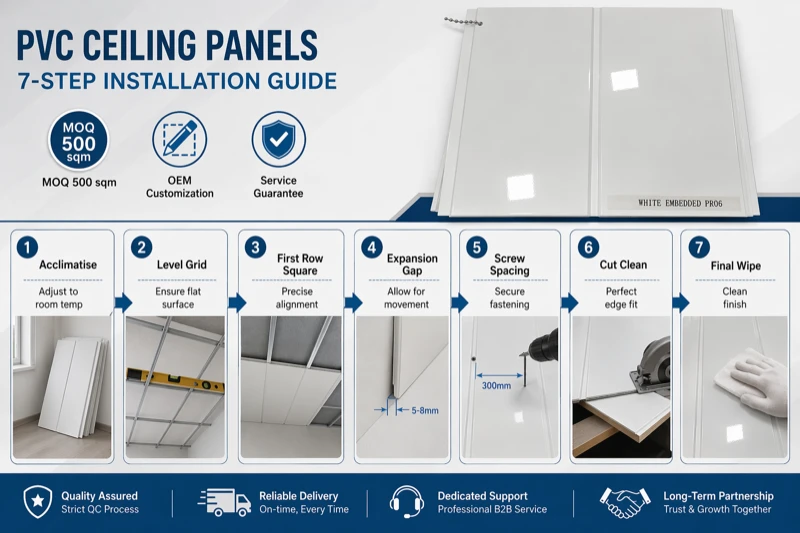
- Acclimatise the stock. Unwrap and lay flat in the installation space for 24–48 hours before cutting. PVC moves ~0.06mm per metre per degree Celsius. If you cut a 6-metre sheet straight off a cold truck in a heated room, you will see a 2–3mm gap open at the joint within 48 hours. The client calls it a defect. It is not — it is thermal expansion physics that the fitter ignored.
- Grid first. Level the suspension grid to ±2mm across any 3-metre span. Use a laser, not a spirit level. A 4mm dip in the grid telegraphs through the PVC as a visible wave under raking light.
- Start square. First row must be dead parallel to the reference wall. If the first row is 3mm out of parallel at one end, by row 20 you have a 60mm taper — and a ripped tapered strip that looks like amateur hour.
- Expansion gap at perimeter. Leave 5–8mm at every wall junction. The PVC will expand. If you butt it tight to the wall, it will buckle in summer. Cover the gap with an L-angle trim — that is what the trim is for, not decoration.
- Fastener spacing. Screws at 300mm centres into steel furring, 250mm centres into timber. Do not over-drive. The screw head should sit flush, not countersunk into the PVC.
- Cut with a fine-tooth blade. 60-tooth TCT blade on a mitre saw, or a fine-tooth hacksaw with a cutting guide. Coarse blades chip the edge and the joint looks ragged.
- Clean as you go. Wipe each sheet with a dry microfibre before the next one goes up. Sawdust trapped between sheets shows as dark lines through the joint.
What Goes Wrong
- No acclimatisation. Cold sheets cut to length, installed, heat comes on — 3mm gaps at every joint. The entire ceiling needs redoing. We have seen this on a 120-room hotel project in the Philippines. The developer tried to blame the panels. Our tech team flew out, documented the storage condition (shrink-wrapped on pallets in an unheated loading bay at 8°C), and the claim died.
- Grid out of level. Wavy ceiling under downlights. Instantly visible. No fix except strip and re-grid.
- Screws over-driven. The screw punctures the top skin of the hollow core, crushing the chamber. The face dimples. Under raking light from a window, every dimple shows.
- Wrong adhesive for direct-bond. Solvent-based construction adhesive attacks PVC, softening the back face and causing the sheet to sag within weeks. We specify neutral-cure hybrid polymer or neutral-cure silicone only. Anything with toluene in the SDS — do not use it.
- Sawdust between tongue and groove. Fitter cuts 20 sheets, stacks them, sawdust falls into the grooves. Installed without cleaning — dark lines radiate from every joint. The ceiling looks dirty before the job is even handed over.

PVC Ceiling Panel vs Gypsum vs Aluminium vs Mineral Fibre —
The TCO Calculation Contractors Actually Use
| Factor | PVC (Eastopo 250mm × 8mm) | Gypsum Board (12.5mm) | Aluminium (0.6mm perforated) | Mineral Fibre Tile (600×600mm) |
|---|---|---|---|---|
| Material cost (ex-factory) | $1.20–$2.50/m² | $0.80–$1.50/m² | $6.00–$12.00/m² | $3.00–$6.00/m² |
| Installation speed (2-man crew/day) | 40–60 m² | 12–18 m² (over 3 visits) | 25–35 m² | 30–50 m² |
| Labour cost (at $25/hr, 8hr day) | $400/day ÷ 50m² = $8/m² | $1,200 across 3 visits ÷ 15m² = $80/m² | $400/day ÷ 30m² = $13/m² | $400/day ÷ 40m² = $10/m² |
| Finishing required | None | Joint compound, sand, prime, 2× paint | None | None |
| Water damage risk | Zero (non-absorbent) | Catastrophic (replacement) | Zero (but stains) | High (stains, sags, mould) |
| Mould resistance | Inherent | Requires MR board upgrade | Inherent | Requires MR treatment |
| Service life (indoor, dry) | 15–20 years | 15–25 years (if no leaks) | 20–30 years | 10–15 years |
| Maintenance | Wipe with damp cloth | Repaint every 5-7 years | Wipe, but scratches show | Vacuum, cannot wash |
| Acoustic performance | NRC 0.05–0.15 (add rock wool above for NRC 0.55+) | NRC 0.05 | NRC 0.60–0.85 (with acoustic fleece) | NRC 0.50–0.70 |
| Fire performance | B-s2,d0 (EN 13501-1) | A2-s1,d0 | A1 | A2-s1,d0 |
| Installed TCO (5 years, incl. maintenance) | ~$18–$25/m² | ~$90–$120/m² | ~$35–$55/m² | ~$30–$50/m² |
PVC does not win on fire class — gypsum and aluminium beat it there. If the spec calls for A1 or A2-s1,d0 on fire, you are not using PVC. But on installed cost per square metre over a five-year hold period, PVC is roughly one-fifth the TCO of gypsum board. That is the number that gets a developer's attention.
On acoustics, PVC alone is poor. Add a 50mm rock wool blanket above the panels and you get NRC 0.55+. For open-plan offices requiring NRC 0.70+, aluminium perforated panels with acoustic fleece are the correct spec. We tell clients this upfront — overselling acoustic performance poisons the relationship when the post-occupancy test comes back below spec.
Where PVC Ceilings Get Specified — And Where They Should Not
Strong Applications
- Multi-unit residential bathrooms and kitchens. 200 identical units, each with a bathroom ceiling. PVC installs in one day per unit versus three visits for gypsum. The programme saving on a 200-unit block is roughly six weeks.
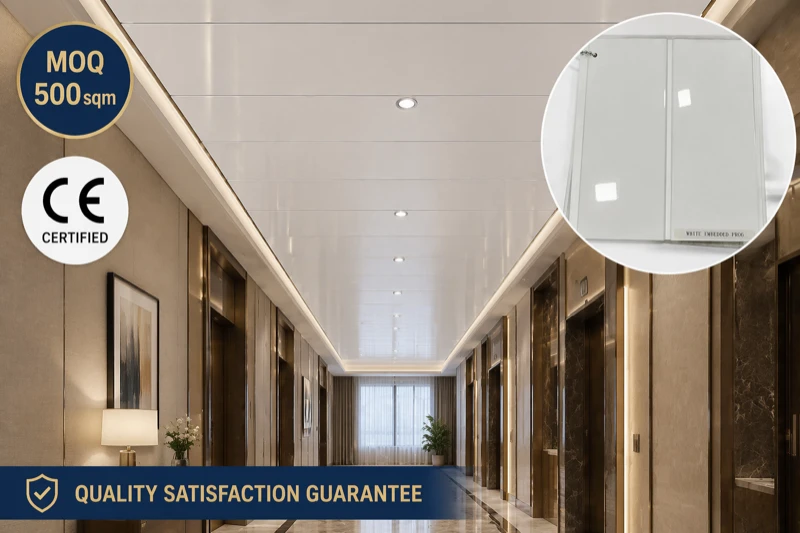
- Hotel corridors and guest bathrooms. Water from the floor above is a when scenario, not an if. A PVC ceiling survives it. Gypsum does not. Hotel operators budget for ceiling replacement every 5–7 years with gypsum; with PVC they budget for wiping.
- Healthcare — corridors, waiting areas, wet rooms. Infection control likes non-porous, wipeable surfaces. PVC does not support mould growth and can be cleaned with standard hospital-grade disinfectants.
- Basement and semi-basement common areas. High ambient humidity, condensation risk, occasional pipe leak. These conditions destroy gypsum and mineral fibre. PVC ignores them.
- Retail and supermarket sales floors. Large open spans, fast fit-out timeline, low maintenance. PVC with a wood-grain or matte white finish gives a clean commercial look at a price point that works for 2,000 m² of ceiling.
- Education — classrooms and corridors. Budget-constrained, high-traffic, needs to survive impact from chairs and bags. PVC flexes instead of cracking.
Where PVC Is the Wrong Call
- High-temperature environments. Saunas, steam rooms, industrial drying rooms. PVC Vicat softening point is 75°C. Sustained ambient above 55°C will cause sag. Use aluminium or stainless steel.
- Fire-rated escape routes requiring A1/A2. Stairwells, protected corridors in high-rise. PVC is B-s2,d0 — check your local building code. Some jurisdictions accept it behind a sprinkler system; some do not. Do not assume.
- External soffits with direct sun. UV will degrade PVC over time even with inhibitors. For external ceilings, specify aluminium or fibre cement.
- Recording studios and cinemas requiring NRC >0.80. PVC alone will not meet the spec. Aluminium perforated + acoustic fleece is the correct route.
Quality Control — What Happens Before the Container Door Closes
Every production batch goes through a five-gate QC checkpoint before it gets a release stamp. This is not optional. We have rejected entire batches and rescheduled shipments rather than let sub-spec product leave the factory floor.
- Incoming resin QC. PVC resin lot certification reviewed before compounding. Calcium carbonate particle size distribution checked. Recycled material: zero. We do not run regrind in ceiling panel extrusion — the impact resistance drops below EN 13245-2 minimums at anything above 5% recycled content.
- In-line dimensional monitoring. Laser micrometer at the calibration die exit. Width and thickness recorded every 15 seconds. Alarms trigger at ±0.3mm drift. Operator adjusts die temperature within 2 minutes or the line stops.
- Surface inspection. Two inspectors per shift at the outfeed table. Check for print registration misalignment (>0.5mm = reject), surface scratches, colour variance against master sample. Rejected sheets get ground for non-ceiling applications — never re-extruded into ceiling panels.
- Physical testing per batch. One sample per 500 sheets goes to the lab. Impact test (1kg/0.5m, -10°C conditioned), Vicat softening point, dimensional stability (60°C/24h, shrinkage <0.5%). Results logged against batch number — traceable to raw material lot.
- Final audit before packing. Random pull of 5 sheets per pallet. Check tongue-and-groove fit by assembling a 3-sheet run. If any joint gaps exceed 1mm or the assembly shows visible bow, the pallet gets stripped and re-inspected.

Our CE certificate (SC-PSC-4-2026-06-54, EN 13245-2:2008) covers PVC wall and ceiling panels produced in Haining. Type testing conducted by Certification Center LTD, Latvia. Factory production control audited annually. TUV factory-verified. AVCP System 4.
B2B Trade Terms — How a Factory Order Works
MOQ
500 m² per colour for standard widths (100–400mm). 1,000 m² per colour for 600mm width. Mixed container: yes — we combine colours and widths in one 40HQ. Each colour minimum still applies.
Production Lead Time
15–35 calendar days from deposit clearance, depending on line schedule at order confirmation. We will give you a firm ex-works date within 48 hours of receiving the PO.
Ocean Transit (estimated)
| Destination | Transit Days | Typical Port |
|---|---|---|
| UK / EU | 25–45 | Felixstowe, Southampton, London Gateway, Liverpool, Grangemouth, Belfast |
| Australia | 21–28 | Sydney, Melbourne, Brisbane |
| West Africa | 30–45 | Lagos, Tema, Abidjan, Dakar |
| East Africa | 25–35 | Mombasa, Dar es Salaam |
| Middle East | 20–30 | Jebel Ali, Doha, Dammam |
| Southeast Asia | 7–15 | Port Klang, Jakarta, Manila |
Incoterms
EXW Factory, FOB Ningbo/Shanghai, CIF destination port.
OEM / Private Label
Custom packaging with your brand, SKU codes, and installation instructions in your language. MOQ for OEM packaging: 2,000 m² per design. Custom dimensions (non-standard width or length): tooling cost applies, amortised at 5,000 m².
Sample Policy
Sample size samples are free, shipped freight collect (you pay the courier). Sample shipping cost rebated against your first container order.
How to Verify a PVC Ceiling Panel Supplier Before You Order
Verify four things before you pay a deposit: the legal entity on the invoice, the physical plant, a certificate number you can look up yourself, and whether the supplier will let you inspect a batch before it ships. A supplier who will give you a price but not those four is asking you to carry the risk on trust alone.
Eastopo is run by Hangzhou Eastopo New Materials Technology Co., Ltd., with PVC panel extrusion in Haining, Zhejiang — 36 extrusion lines, a monthly capacity of 600,000 to 800,000 m², and certificate SC-PSC-4-2026-06-54 to EN 13245-2:2008 issued on 25 June 2026 by Certification Center LTD (Sertifikacijas centrs SIA), Riga.
What exactly should I ask for before I pay a deposit?
Start with the entity name. The company that invoices you should be the same legal entity named on the certificate, because that is what your bank and your customs broker will check. A factory address is checkable; a "trading office" address often is not.
Then ask for the certificate number, not a certificate picture. Numbers can be looked up and matched against the product you are buying; screenshots cannot.
Finally, test whether the supplier will let you see the line. Ask for a live video walkthrough of the extrusion hall, a retained sample of the exact batch, and a pre-shipment inspection before the balance is due. Depending on your state you may not need a business licence simply to import, but you do need a supplier willing to invoice a named legal entity and to be inspected — that is what protects a first order.
Pre-Shipment Inspection — and What Happens If a Batch Is Wrong
Check the batch, not the brochure. Before the balance is released, ask for four things: a retained sample of the actual production batch, the thickness measurement against the agreed tolerance, how the tongue and groove fits on a dry joint, and photographs of the loaded container with carton marks readable.
How do I check a batch, and what happens if it arrives wrong?
Thickness is where most disputes start, because a hollow-core plank that is under gauge flexes more across a ceiling span. We work to a ±0.2 mm tolerance on panel gauge, and every batch passes a five-gate QC checkpoint before it gets a release stamp — a batch without that stamp does not ship. Colour also has to be checked run to run, not against a single swatch, since ceiling panels are installed side by side.
You are welcome to appoint a third-party inspector; inspections are arranged on the production batch before packing, not after loading. If a batch still arrives wrong, the evidence set matters more than the complaint: batch code, carton marks, photographs of the affected planks, the inspection report, and the count of affected pieces. That set lets the fault be traced back to a production batch rather than argued about. Damage that happened in transit follows the carrier and the insurance route, which is fixed by the Incoterm on your order.
Who Handles Customs and Duties on a Wholesale PVC Ceiling Panel Order
Short answer: the importer of record pays the duty and the import taxes, and what changes between quotes is where our responsibility ends. We quote EXW, FOB, CFR and CIF only — never delivered-duty terms — so the split is predictable before you fix your landed cost.
Which Incoterm should I choose, and who clears customs at my end?
EXW ends at our factory gate: you arrange collection, export clearance and freight. FOB ends once the container is loaded and export-cleared at the port of loading. CFR means we pay the ocean freight to your destination port; CIF adds marine insurance on top of that. Under all four, destination customs clearance, duty rates and the HTS classification sit with you and your broker.
That is why we send the commercial invoice and the packing list with the shipment: your broker needs the invoiced value and the panel description to classify the goods and to quote you the duty before the container lands, rather than after. Duty rates and de minimis treatment change, so confirm the current figure for your HTS code with your broker instead of budgeting on last season's number. On cost per panel shipped, the driver is loading, not freight rate alone — a full 40HQ loaded with the widest format your span allows usually beats two part-loads, which is why we confirm the size list before quoting freight.
MOQ, Private Label and Factory vs Distributor: How Our Terms Actually Work
Our minimum order is 500 m² per colour for standard widths, and 1,000 m² per colour for the 600 mm format, because a colour run has to be scheduled as one extrusion batch. Trims are 300 pcs per colour. Private-label and OEM runs are quoted per SKU, since the printed carton requirement sets the minimum for that SKU — ask for the figure against your own specification rather than assuming the panel MOQ applies to printed packaging.
What does OEM tooling cost, and how does a factory compare with a distributor?
OEM tooling is a separate line item, and what it covers depends on what you are changing. A printed carton or a private-label film is a packaging change: the cost sits in the printing set-up, it is quoted per SKU, and the panel itself is unchanged. A new profile — a different tongue-and-groove geometry, or a width outside our standard list — needs its own extrusion die, which is a one-off charge. Two things are fixed in writing before the die is cut: the tooling charge, and the volume at which that charge is refunded to you. The die belongs to you.
Comparing a factory with a distributor on price alone hides the parts that are hardest to price. Specification ownership: on a factory order the gauge, length and colour run are set to your requirement rather than to whatever is already in a warehouse. Traceability: a factory order can be tied to the production batch and to the inspection record for the material you actually receive, which is what an inspector or a project specifier will ask for. Lead time and order flexibility: this is where a distributor wins, because stock means a shorter wait and a smaller first order. Accountability: a factory order is traceable back to the line that made it, whereas through a distributor your counterparty is the importer rather than the producer. Which of those four matters most to your project is what should drive the choice — and when a distributor is genuinely the better answer for a given order, we will say so.
One more check worth doing before you compare two quotes: if the quote says WPC, ask whether the panel contains wood fibre. Our WPC wall panels are extruded PVC with a laminated wood-look film and contain no wood fibre; wood-fibre WPC is a different product, so a quote built on one cannot be compared line for line with the other. Every Eastopo ceiling panel is a hollow-core PVC profile with parallel rectangular channels, and we will state the gauge, length and colour on the quotation.
Trim and Accessories — The Parts That Make the Ceiling Look Finished
A PVC ceiling without proper trim looks unfinished. Every project needs:
- PVC Internal Corner — inside 90° junction where ceiling meets a soffit or bulkhead
- PVC External Corner — outside edges on dropped bulkheads
- PVC End Cap / U-Channel — perimeter closure at wall junction, hiding the expansion gap
- PVC H-Joint Connector — end-to-end joining when a run exceeds the max sheet length
- PVC L-Angle Profile — edge finishing and corner protection
We stock matching trim in the same colours and surface finishes as the ceiling panels. Mixed shipment in the same container — no minimum order per trim profile when shipped with panels. See our Wall Panel Trim page for full specifications.
Adhesive Specification — Critical If You Are Direct-Bonding
For suspended grid installation, adhesive is not required — the panels clip into the furring channels. But when the spec calls for direct-bond to a level substrate (concrete soffit, plywood backing), the adhesive choice makes or breaks the installation.
Specification: Solvent-free hybrid polymer construction adhesive or neutral-cure silicone sealant. Coverage: one standard 300ml cartridge per 2.4 m² of panel, applied in vertical beads at 200–250mm spacing. Do not use solvent-based construction adhesive — the toluene and xylene in standard grab adhesives attack the PVC back face, causing softening and eventual sag. If your fitter reaches for a tube that smells like a paint factory, stop them.
Open time at 20°C: approximately 15 minutes. Full cure: 24 hours. Do not load the ceiling (lights, speakers, access hatches) until the adhesive has fully cured.
FAQ — Questions We Get from Contractors and Distributors
Are PVC ceiling panels waterproof?
A PVC ceiling panel is a hollow-core extrusion made from 100% virgin PVC compound, so the sheet itself is waterproof end to end, including cut edges. It does not swell, delaminate or feed mould, which is why the profile is the default spec for bathrooms, kitchens, basements and other moisture-prone ceilings. The UV-cured topcoat seals the printed layer against steam and condensation. Water from a leak above pools on the ceiling and wipes clean — no plaster repair, no repaint.
Are PVC ceiling panels suitable for bathrooms?
Yes, bathrooms are the biggest single application for PVC ceiling panels. The material is 100% waterproof, mould-resistant and wipes clean with a damp cloth, so it survives the steam and condensation of a shower room without the sagging or staining you get with gypsum board. Eastopo ships bathroom ceiling panels at widths from 100mm to 600mm and lengths to 5.95m. For a project spec, ask for the 7.0–8.0mm range with a cold HD transprint finish and UV topcoat.
What is the difference between PVC ceiling board, sheet and panel?
They are the same product family, labelled by market. African and South Asian buyers order "PVC ceiling board" — a rigid 200mm or 250mm tongue-and-groove plank, typically 5.95m long. Middle East and Southeast Asian wholesalers order "PVC ceiling sheet" — often jumbo 1,220mm x 2,440mm boards for grid systems or thickness above 10mm. "PVC false ceiling" or "PVC suspended ceiling" describes the installed system below the structural slab. Eastopo runs the same dies and compound for all three; only the box label changes.
Can PVC ceiling panels be used in kitchens?
Yes. Kitchen grease and cooking steam are exactly what the UV-cured topcoat is designed for — one pass with a damp microfibre cloth removes the film that builds up on painted ceilings. The panels are easy to cut around extractor hoods and light fittings, and an individual sheet can be replaced without disturbing the rest of the ceiling. Keep the panels away from direct flame and do not install within 500mm of a gas hob; the Vicat softening point of PVC is 75°C.
Do PVC ceiling panels yellow over time?
Not if you spec UV-stabilised compound and keep them out of direct sun. Our indoor-grade formulation uses hindered amine light stabilisers (HALS) and UV absorbers. Accelerated ageing tests (500-hour xenon arc, ISO 105-B02) show Grade 4 colour fastness minimum. We warrant against yellowing for 10 years under normal indoor lighting. Ceilings in rooms with large south-facing windows will degrade faster — that is UV physics, not a product defect. Recycled PVC panels from unknown sources yellow within 2–3 years because the stabiliser package was consumed in the first life cycle.
Does PVC ceiling contain formaldehyde?
PVC itself does not contain formaldehyde. Our extrusion compound is formaldehyde-free, tested to E0 (≤0.5 mg/L) under EN 717-1, and the test report is available on request. Note that some acoustic backings and adhesives used with PVC ceilings do contain formaldehyde — check the full ceiling system, not just the panel. If a project has strict indoor air quality limits, specify our E0-grade compound and neutral-cure adhesives and you stay within the limit.
How do you replace a damaged panel after installation?
Individual panel replacement is straightforward because of the tongue-and-groove system. Use a thin pry bar to release the tongue from the groove on both sides, slide the damaged sheet out, cut a replacement to length and clip it in. A fitter with experience can swap a single 3-metre sheet in under 15 minutes without disturbing the rest of the ceiling. Keep a few spare sheets from the original batch in the project store for fast callbacks — we recommend 2% overage on the order for exactly this reason.
What is the MOQ, lead time and HS code for wholesale orders?
Standard wholesale MOQ is 500 m² per colour for widths up to 400mm, and 1,000 m² per colour for 600mm width; OEM packaging starts at 2,000 m² per design. Production lead time is 15–35 days from deposit clearance, with a firm ex-works date within 48 hours of the PO. The HS code for PVC ceiling panels is 3925900000, which covers the extruded profile family and simplifies customs clearance for your forwarder.
Are PVC ceiling panels any good?
Yes, for the right rooms. PVC ceiling panels are fully waterproof, wipe clean with a damp cloth, and install in a fraction of the time of plasterboard — which is why contractors and distributors specify them for bathrooms, kitchens, basements and hotel corridors. The hollow-core tongue-and-groove plank holds its geometry for years without sagging when fixed to level furring, and a damaged sheet swaps out in minutes. In formal living rooms where a plastered finish is expected, gypsum still looks more premium — choose the product for its strengths.
What are the disadvantages of a PVC ceiling?
Three honest limitations. First, a PVC ceiling is a decorative lining fixed to furring, not a structural ceiling, so it carries no load and services need access panels. Second, direct sunlight accelerates yellowing — spec UV-stabilised compound and avoid long runs under south-facing skylights. Third, PVC softens near direct heat: keep panels away from naked flames and at least 500mm from gas hobs, since the material softens above 75°C. Where a premium plastered look is required, gypsum remains the better finish.
How much do PVC ceiling panels cost?
PVC ceiling panels are priced per square metre at the factory gate, and the unit price moves with width, thickness, finish and order volume — there is no fixed list price. Standard wholesale pricing starts from the 500 m² per colour MOQ, or 1,000 m² for the 600mm width. Send your target spec, quantity and destination port, and you receive a written quotation within 24 hours on EXW, FOB, CFR or CIF terms — no distributor mark-up between the extrusion line and your container.
Eastopo vs the Market — What We Actually Sell, Not What the Brochure Says
We are a mid-sized PVC ceiling panel manufacturer running our own extrusion lines in Zhejiang province, not a trading company reselling someone else's production. When you request a quote, the technical data comes from our own QC lab, not a supplier's brochure. The lead time is based on our line schedule, not a third party's promise. If there is a quality issue, our manager answers the phone — not a trader who needs to call the factory first.
We do not claim to be the cheapest PVC ceiling panel on the market. Alibaba search results will show you $1.20/m² listings from traders who have never seen the production floor. Those panels typically run 40% recycled content, skip the UV stabiliser package, and carry no traceable certification. They look identical in a product photo and fail within two years on site. If your business model is one-off tenders where you never see the client again, buy the cheap stock. If you need a supply chain that stands behind the product for the warranty period, we are the right tier.
More technical specs, installation know-how, and logistics updates in our Knowledge Center.
About the Author
Written by J. Mao — Export Manager, Eastopo New Materials (Hangzhou, China). J. Mao works with distributors and contractors on PVC wall and ceiling panel specifications, certification documentation and container planning. For project questions, email mj@eastopo.com or WhatsApp +86 193 5725 8106.
As one of the most professional pvc ceiling panel manufacturers and suppliers in China, we offer a wide range of products with superior quality. Please rest assured to wholesale custom made pvc ceiling panel from our factory. Good service and reasonable price are available.
PVC Shower Ceiling Panel, Interior PVC Ceiling Panel, PVC Porch Ceiling Panel