



What Is a PVC UV Marble Sheet?
A PVC marble sheet is an interior wall panel that reproduces natural stone veining on a rigid PVC board, sealed under a UV-cured coating. The build is a four-layer stack: a solid PVC substrate, a high-definition printed marble film, a UV-cured clear coat, and a PE protective film that the fitter peels off after installation. That construction is what separates a genuine UV marble sheet from a plain printed sheet. The UV layer carries the hardness, the print carries the pattern, and the PVC board carries the dimensional stability. For an importer the distinction decides how the sheet behaves in a hotel lobby, a lift car or a retail wall after two years of traffic.
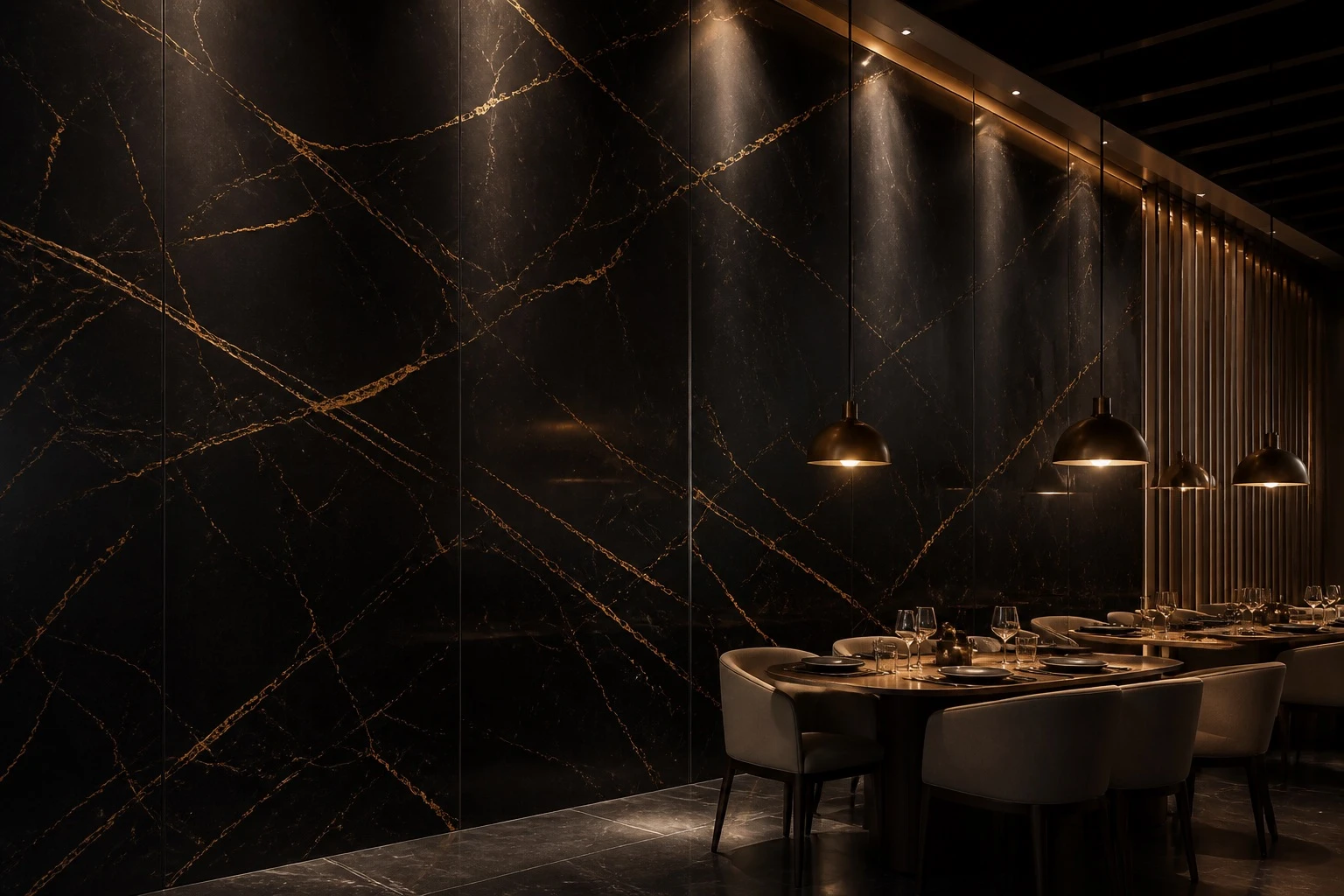
Natural marble looks the part but brings weight, porosity and a demanding install. A UV marble sheet keeps the veining and the gloss while cutting the weight to roughly a tenth of stone, which changes the whole logistics and fixing picture for a project. No structural reinforcement, no crane, no specialist stone setter. That is why the product moved from a niche decorative item to a standard specification in commercial interiors. The same sheet is listed under different search names in different markets: pvc marble sheets for walls is the common UK phrase, while US buyers search pvc marble wall panels. Importers typically mirror both terms in their own listings.

Sheet Formats and Dimensions
Large-format sheets are the point of this product. Standard width is 1220 mm, which matches the 4 ft module used across US and European joinery. Lengths run 2440, 2600 or 2900 mm, with thickness from 2.0 to 5.0 mm in solid PVC board. A 1220 x 2440 mm sheet is a true 4 x 8 ft board and covers 2.98 sqm. That arithmetic matters when you quote a job: a 60 sqm lobby wall needs about 21 sheets with an allowance for cutting. Fewer sheets mean fewer seams, and fewer seams mean a calmer marble look with less pattern matching on site.
For marble sheets for walls in non-standard ceiling heights, the 2600 and 2900 mm lengths cut wastage on commercial storeys where the stud wall runs full height. Custom lengths and thicknesses are available for OEM runs, and the factory will advise on the practical limits for freight and handling before you commit to an unusual size.
| Feature | Specification | What It Means on Site |
| Dimensions | Width 1220 mm; Length 2440 / 2600 / 2900 mm | 4 x 8 ft module, full-height options, fewer seams per wall |
| Thickness | 2.0 - 5.0 mm solid PVC board | Thicker boards suit high-traffic walls and larger spans |
| Material | PVC substrate with a screened proportion of recycled PVC, calcium-zinc stabilisers | Lead-free, cadmium-free formulation |
| Surface | HD printed marble film under a UV-cured coating, 2H+ pencil hardness | Scratch-resistant gloss that holds the print |
| Water absorption | 0.5% or less, tested to EN 13245-2 section 5.4 | Suitable for bathrooms, kitchens and wet zones |
| Protection | PE protective film, removed after installation | Factory shipping protection, not a surface finish |
| Certification | CE to EN 13245-2 for solid PVC profiles | Compliant for EU and UK specification |
| MOQ | 500 sqm per colour and finish | Container-friendly ordering for importers |
| Lead time | 18-22 days stock; 28-35 days custom | Plan reorders against project programmes |
| Incoterms | EXW / FOB / CFR / CIF | Quoted per shipment method |
How the UV-Cured Surface Is Built
Surface quality is decided on the line, not in the showroom. Four stages run in sequence: a sanded PVC substrate, a high-definition print, a UV cure and a protective film, and each one leaves a mark on the finished sheet.
The Substrate and the Print Layer
The PVC substrate is extruded and sanded flat, then the marble pattern is printed in high definition. The board carries the dimensional stability and the print carries the pattern, so both have to be right before any coating goes on.
The UV Cure: Where the Hardness Comes From
The cure step is the one that separates good sheets from cheap ones. Ultraviolet light cross-links the liquid coating into a hard, glossy skin rated at 2H+ pencil hardness. That skin absorbs the scratches, the solvent splashes and the scuffing that would otherwise sit on the print below.
A genuine UV marble sheet keeps its gloss where a non-UV printed sheet dulls within months. When a supplier cannot show you the coating stage or a hardness test result, treat the claim with caution. The difference shows up in year two, not in the sample photo.
The PE Protective Film
A PE protective film is laminated over the cured surface and peeled off by the fitter after installation. It keeps the gloss clean from the line to the wall, so the sheet arrives on site in the state it left the factory.
Where Marble Sheets Are the Wrong Call
Every material has jobs it should not take. A PVC marble sheet is a decorative wall finish, not a structural board, and honest suppliers say so up front. Skip it when the wall is uneven. A bow of more than a few millimetres over a sheet length shows through the seams no matter how carefully the fitter works, and on a gloss surface every imperfection reflects. Skip it where strong solvents live near the wall. Acetone, banana oil and industrial thinners attack the UV coating and leave dull patches that cannot be polished back.
Skip it when the wall leaks. The sheet is waterproof; the cavity behind it is not. Water trapped behind the panel turns into mould, and the first sign is a smell, not a stain. And when a project specifies a fire-rated wall assembly, check the requirement against the product datasheet before pricing the job. Do not assume a decorative panel carries a rating it was not tested for. For a fitter the rule is simple: flat wall, dry wall, right spec, or walk away.
PVC Marble Sheet vs Ceramic Tile vs Stone Veneer
Buyers comparing finishes usually weigh three options: PVC marble sheet, ceramic tile and stone veneer. The comparison comes down to weight, installation speed and pattern control.
| Factor | PVC Marble Sheet | Ceramic Tile | Stone Veneer |
| Weight on wall | Around one-tenth of stone; light enough for one-person handling | Heavy; adds wall load | Heaviest; structural substrate and lifting gear needed |
| Installation | Dry-trade; one-day finish for a feature wall | Wet-trade schedule; adhesive, grout and curing time | Slower fitting on heavier substrates |
| Joints and seams | Large-format sheets, so few seams per wall | Grout lines on every tile | Slab joints vary with size and layout |
| Pattern control | Printed pattern locked by shade number, batch to batch | Pattern shifts batch to batch | Natural veining; cannot be matched |
| Water resistance | Waterproof; 0.5% absorption or less (EN 13245-2 section 5.4) | Waterproof, but grout lines need sealing and care | Porosity varies; needs sealing |
| Maintenance | Soft cloth and mild detergent | Grout cleaning and periodic resealing | Sealing and specialist cleaning |
| Installed cost | Factory-direct; lowest of the three | Moderate; materials plus fixing and labour | A multiple of the installed cost |
| Repairs | Light scratches polish out of the UV skin | Cracked tiles must be cut out and replaced | Chipped edges need specialist repair |
For lobbies, lift cars, reception walls and retail fit-outs where the look must land on a programme, the PVC sheet wins on speed and consistency. The trade-off is honest: a genuine stone wall takes knocks that a coated sheet will mark. Choose by traffic and budget, not by showroom impression.
What Importers Check Before Ordering
When you buy marble sheets in container volume, the sample board tells you less than the production checks. Four things matter before you commit.
Thickness Tolerance
Caliper a sheet at several points, because a 3 mm board should read 3 mm and not 2.7 at the edge.
Pattern Consistency Across Batches
Ask for photos of two different batches in the same colour and compare the veining direction and density. Eastopo locks shades by batch number so repeat orders land the same colour.
Coating Hardness and Water Absorption
A 2H+ pencil test on a sample edge is a five-minute check that filters out non-UV printed sheets. For wet zones, ask for the EN 13245-2 section 5.4 water absorption result; Eastopo boards hold absorption at 0.5% or less.
How to Install Large-Format Marble Sheets
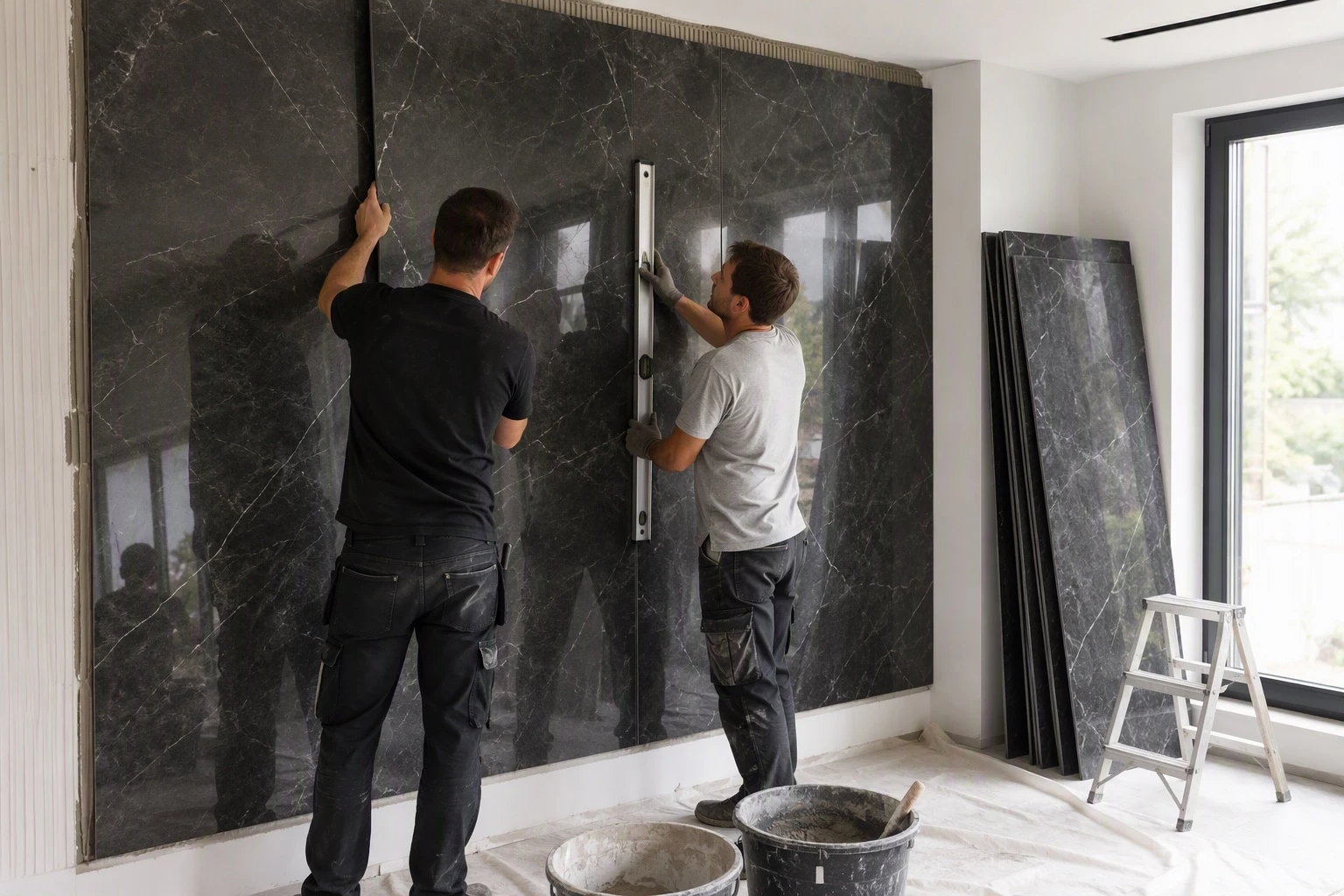
Installation is a two-person job and a one-day finish for a typical feature wall. Step 1: prep the substrate. The wall must be flat, dry and free of loose paint; fill hollows, sand ridges and prime porous plaster. Step 2: dry-lay the sheets. Stand them against the wall, check the pattern flow, mark cut lines, and number the sheets so the veining continues across the wall. Step 3: apply the adhesive. Use a structural adhesive or a notched-trowel tile adhesive combed in one direction; do not spot-dab large sheets, because air pockets read as ripples on a gloss surface. Step 4: press and level. Work each sheet with a roller or a clean block from the centre outwards to expel air, and check levels across seams as you go. Step 5: cut and trim. Score thin sheets and snap, or cut thicker boards with a jigsaw on a clean guide line, then sand cut edges lightly. Step 6: finish the edges. Cap ends with the aluminium trim profiles for a neat job, and wipe the surface down after the adhesive cures. In showers, seal the bottom edge before fitting.
Cleaning and Long-Term Care
Daily care is a soft cloth and a mild detergent. Wipe along the surface rather than in circles, and rinse any soap residue in wet rooms. Do not use abrasive pads, scouring powder, acetone, banana oil or solvent-based cleaners. The UV coating is hard, but it is not indestructible, and solvent damage shows as dull patches that polishing cannot fix. Light scratches can be touched up with a fine polishing compound on a soft pad.
Keep the PE protective film on the face of the sheet until installation is finished; it is factory shipping protection, not a surface you install. In kitchens, wipe grease promptly. In bathrooms, dry standing water at cut edges. Ten minutes of care a month keeps a marble wall looking like the showroom sample.
FAQ
What are PVC marble sheets used for? +
Interior wall cladding in lobbies, lift cars, living room accent walls, kitchens, bathrooms, shopfits and office corridors. The waterproof PVC substrate and the scratch-resistant UV coating suit high-traffic commercial areas where a stone look is wanted without stone weight or cost. Importers commonly stock them for distributors who supply fitters and renovation contractors.
What are the disadvantages of PVC marble sheets? +
They are not structural, so the wall behind must be sound and flat. Strong solvents, acetone and abrasive pads can damage the UV coating. Like any wall covering, they hide moisture problems rather than solve them, so a leaking wall must be fixed first. Where a fire-rated assembly is specified, the project requirement must be checked separately. Pattern matching across sheets needs care on busy veining.
How much does a PVC marble sheet cost? +
Retail pricing for a 4 x 8 ft sheet, 1220 x 2440 mm, typically runs from about USD 40 to 130 depending on thickness and finish in the US market. Factory pricing is quoted per square metre and scales with thickness, surface finish and order volume. Eastopo quotes per project at a MOQ of 500 sqm per colour and finish. Request a factory quotation for your job.
How long does a PVC marble sheet last? +
With a UV-cured coating at 2H+ pencil hardness and a moisture-stable PVC substrate, interior sheets typically hold their print and gloss for a decade or more in normal commercial use. The PE protective film is removed after installation. Performance depends on cleaning habits, soft cloth and mild detergent, and on the wall behind staying dry.
Can PVC marble sheets be used in bathrooms? +
Yes. The substrate is waterproof, with water absorption of 0.5% or less tested to EN 13245-2 section 5.4, and the UV surface resists steam and condensation. Seal cut edges at the shower line and keep the wall behind free of leaks. Sheets beat tiles on installation speed in wet-area refits where tiles mean a full wet-trade programme.
What is a UV marble sheet? +
A UV marble sheet is a PVC sheet whose printed marble pattern is sealed under a layer of ultraviolet-cured coating. The UV process hardens the surface to 2H+ pencil hardness, protecting the print from scratching, yellowing and daily wear. Plain printed sheets without UV curing lose gloss and pattern clarity far faster in high-traffic interiors.
How do you cut and clean marble sheets? +
Cut with a fine-tooth blade, a scoring knife for thin sheets, or a jigsaw on a clean guide line. Clean with a soft cloth and mild detergent, wiping along the surface. Avoid abrasive pads, acetone, banana oil and other strong solvents, which attack the UV coating. In wet rooms, wipe standing water off cut edges.
What sizes are PVC marble sheets available in? +
Standard sheet width is 1220 mm, with lengths of 2440, 2600 and 2900 mm and thicknesses from 2.0 to 5.0 mm. A 1220 x 2440 mm sheet equals a 4 x 8 ft board and covers 2.98 sqm. Custom lengths and thicknesses are available for OEM runs. Check the pattern repeat before ordering a large area.
About the Author
Written by J. Mao - Eastopo New Materials. J. Mao is the Export Manager at Eastopo, a Chinese manufacturer of PVC wall and ceiling panels supplying distributors, contractors and building material importers worldwide, including the UK, EU, US, Australia and New Zealand. She writes on PVC cladding materials, UV coating technology and B2B building material procurement. For questions about this page or OEM enquiries, email mj@eastopo.com or WhatsApp +86 193 5725 8106.
Ready to spec a marble wall for your next project? Send the wall dimensions and the finish you have in mind to mj@eastopo.com, and we will come back with sheet counts, a factory quotation and a delivery timeline under EXW, FOB, CFR or CIF. Samples ship before you commit. A marble pattern is worth seeing on a real sheet, not in a screenshot.
Hot Tags: pvc marble sheet, uv marble sheet, pvc marble sheets for walls, marble effect wall panels, marble wall sheets, UV Marble, PVC Marble Sheet, Room UV Marble Sheet, UV PVC Marble, uv pvc marble sheet


