

Where an Aluminium Vapour Barrier Sits in the Build-Up
An aluminium vapour barrier works on a different side of the building envelope from a breather membrane, and mixing the two up is one of the most common specification errors on site. The breather membrane goes on the cold side, under the cladding or roof sheet, where it sheds wind-driven rain while letting trapped moisture escape. The vapour barrier goes on the warm side, inside the insulation, where it stops the damp air from a kitchen, bathroom or occupied room from pushing into the fabric in the first place.
Eastopo's Aluminium Vapour Barrier is built for that warm-side job. The membrane carries an Sd value above 100 m, which in plain terms means the water vapour diffusion through the sheet is close to zero. A typical perforated or woven membrane might sit at 0.02-0.05 m Sd; this product is several orders of magnitude tighter. When a build-up has a vapour drive from the interior, a membrane with real vapour resistance is what keeps the insulation dry, the timber frame sound and the dew point away from the cold surfaces where it would otherwise condense.
That distinction matters more than most product brochures admit. The wrong membrane in the wrong position does not fail dramatically; it fails slowly, with condensation appearing inside the wall or roof void months after handover, usually behind the lining where nobody looks until the rot is already established.

Vapour Barrier Sarking or Vapour Permeable Sarking: Read the Climate First
On metal-roof projects in warmer climate zones, Australian specifiers talk about vapour barrier sarking as a distinct product from vapour permeable sarking. The two are not interchangeable, and the choice is a climate decision, not a price decision.
Vapour permeable sarking, which Eastopo also supplies, is the right call for cool and cold climates where the risk is condensation forming on the underside of the roof sheet. The membrane lets that moisture breathe out. Vapour barrier sarking, by contrast, is the traditional reflective foil sarking used in warm climates, where the dominant problem is radiant heat loading and the internal vapour load is handled by the membrane being genuinely vapour-tight.
Eastopo's Aluminium Vapour Barrier belongs firmly in the vapour barrier sarking family. If a project brief calls for a non-permeable reflective sarking under a metal roof or behind cladding in a warm climate zone, this is the product family to spec. If the same project is in a cold climate with a condensation risk on the roof sheet, the spec should switch to Eastopo's vapour permeable sarking instead. Reading the climate first saves a call-back later, and it is the single biggest selection mistake we see from new buyers.
Sd Value Above 100 m: What "Near-Infinite Vapour Resistance" Really Means
The Sd value is the water vapour diffusion equivalent air layer thickness. It is the number a specifier or building control officer looks at first when they check a VCL, and for good reason: it tells you how much the membrane resists vapour diffusion, in metres of still air it is equivalent to.
Eastopo's aluminium vapour barrier measures Sd > 100 m, with moisture transmission at or below 0.5 g/m² per 24 hours. For context, a standard breather membrane is typically 0.02-0.05 m Sd and a heavy polythene VCL might reach 50-100 m. Above 100 m is the territory where the membrane stops acting like a retarder and starts acting like a true barrier: virtually no water molecule passes through the sheet itself.
What this means in practice is that the vapour load arriving at the warm side of the insulation is stopped at the membrane line. It cannot reach the insulation, the timber, the steel or the cold outer surfaces. That is the entire point of a vapour control layer: cut the moisture source off before condensation physics takes over.

The 95% Radiant Reflection Argument: Foil Faces That Pay for Themselves
In the United States market, the same family of products is often specified as a vapor barrier or a radiant barrier. The two functions are not competing; they are stacked in one membrane. Eastopo's aluminium face reflects at least 95% of radiant heat, with an emissivity at or below 0.05. Roofing supply catalogues in North America file this family under radiant barrier products as well as vapor barriers, which is exactly the dual role the membrane plays.
Here is the energy logic. A reflective face adjacent to an air cavity turns the roof or wall assembly into a low-emissivity system: radiant heat from the sun is thrown back out in summer, and radiant heat from the interior is thrown back in during winter. For a metal roof in a warm climate, that can be the difference between a roof void that cooks and one that stays workable. For a building with air conditioning, every reflected kilowatt is a kilowatt the compressor does not have to move.
Numbers matter in a specification review. Reflectivity of 95% and emissivity of 0.05 are the figures a thermal engineer checks against the project's energy model, and they are the figures that make the reflective layer more than a marketing claim. This membrane is not a thin printed film with a foil look; it carries a vacuum-deposited aluminium coating at 99% purity on a PE grid scrim, which is what keeps the reflection performance honest after installation.
Inside the Membrane: the Vacuum-Metallised Film and the PE Grid Scrim
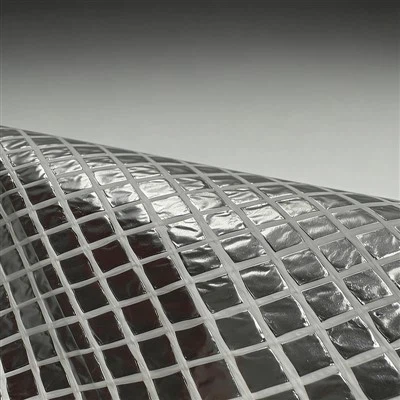
The build of the membrane is where cheap foil products fail and engineered ones hold up. Eastopo's Aluminium Vapour Barrier is a two-layer construction: a vacuum-metallised film with a 99% purity aluminium coating, bonded to a PE grid scrim that carries the mechanical load.
The reinforcement is not decoration. It is the difference between a membrane that survives a roof fitter's boots, dropped battens and a hard day on site, and one that tears at the first snag. The product carries tensile strength of MD ≥ 200 N/5cm and CMD ≥ 180 N/5cm, with trapezoid tear strength ≥ 30 N. At 120-200 g/m² depending on grade, it is heavy enough to handle without flapping in the wind and light enough that one fitter can manage a full roll.

Temperature tolerance is worth noting for anyone specifying in extremes: the membrane holds its performance from -40°C to +120°C, with short-term tolerance up to 150°C. That covers cold-weather installs, hot roof decks in summer, and high-temperature pipe wrapping without the film becoming brittle or delaminating.
When a Foil VCL Fails: Taped Laps, Punctures and the Wrong Side of the Insulation
A vapour barrier is only as good as its seams, and most installed failures trace back to one of three mistakes. The first is sealing: if the laps are not taped with a compatible aluminium foil tape, the membrane becomes a series of independent sheets with a vapour path down every overlap. The second is puncture damage during installation, holes from staple guns, dropped tools or rough decking that never get patched. The third, and most expensive, is orientation: a VCL fitted on the cold side of the insulation, or worse, a vapour barrier fitted where a breather membrane was specified.
The failure mode is slow and structural. Warm, moist air from the interior drives into the insulation and condenses at the cold boundary. Over one heating season the insulation becomes damp and loses R-value. Over two or three, the timber frame begins to decay and steel elements start to corrode at the contact points. Mold establishes in the hidden void. None of this shows on the surface until the damage is done, which is why the British and European specification community treats VCL detailing as a warranty-critical item rather than an accessory.
Eastopo cannot control how a membrane is fitted, but the product is engineered so the install has a fighting chance: a tough reinforced sheet that does not puncture easily, a clean aluminium face that gives foil tape a surface it can actually bond to, and an Sd value high enough that the only leak paths are the ones left open on site.
Installation on Site: Laps, Foil Tape and Cold-Weather Bonding
Installation rules for a reflective vapour barrier are simple to state and easy to rush. The membrane goes on the warm side of the insulation with the foil face toward the cavity it is reflecting into. Laps should be a minimum of 100 mm at sheet edges, and every lap, every nail penetration and every cut must be sealed with an aluminium foil tape compatible with the membrane face. A self-adhesive double-sided tape can carry the initial fixing; the foil tape does the sealing job.
Site temperature matters more than fitters expect. The adhesive on the tape system performs best between 5°C and 30°C. Below 5°C the tape loses tack and the bond weakens before it cures; above 30°C the adhesive becomes too aggressive and picks up dust from the deck, leaving a lap that looks sealed and is not. Where a cold-weather install is unavoidable, the tape should be stored warm and rolled down with a roller rather than pressed by hand, particularly at window and door reveals where the detailing gets the most scrutiny.
Punctures found after installation can be patched with the same foil tape or a membrane patch. Because the membrane is designed to be impermeable, a clean patch does not compromise its vapour resistance. The discipline is the same as for any airtight layer: the envelope is a system, and the weakest lap defines the whole assembly.
High-Humidity Zones: Saunas, Pool Halls, Commercial Kitchens and Ductwork
Some occupancies generate a vapour load that ordinary membranes cannot manage. Saunas and steam rooms push moisture into the fabric continuously. Indoor pool halls combine high humidity with chlorine-laden air. Commercial kitchens cycle hot, wet air all day. Ductwork in humid climates sweats on the cold surface unless it is wrapped in a vapour-tight layer.
These are the applications where a true vapour barrier earns its spec. With Sd > 100 m and moisture transmission at or below 0.5 g/m² per 24 hours, Eastopo's aluminium vapour barrier is regularly considered for exactly these spaces. American specifiers ordering for steam rooms and commercial kitchens list the same material as a vapor barrier for continuous humidity exposure, and the 99% purity aluminium face holds its reflectivity through the heat and chemical load. The aluminium face also reflects radiant heat, which helps keep a sauna's heat inside the room rather than soaking into the frame behind the lining. The smooth, dense surface inhibits bacterial growth, releases no harmful volatiles and sheds no fibres, which matters in hygiene-sensitive environments.

For trade buyers, this is a useful pattern to recognise: the same roll of membrane that closes out a standard roof void also answers the tough cases. Stocking one product family that covers warm-side vapour control from a domestic loft to a pool hall simplifies purchasing, and it is why many of our distributor customers carry this line as their default VCL.
Specifying a Vapour Control Layer for UK and EU Projects
UK and European specification language uses the term vapour control layer, or VCL, for this product type, and the newer AVCL label (air and vapour control layer) when the membrane is detailed as part of the airtightness strategy. The function is the same: a vapour control layer sits on the warm side of the insulation and restricts the movement of humid interior air into the building fabric.
Specifiers in the UK and Ireland should check three things when they receive a VCL submittal: the Sd value, the reaction to fire class and the installation temperature range. Eastopo's aluminium vapour barrier delivers Sd > 100 m, a reinforced build that survives site handling, and a -40°C to +120°C working range that keeps it practical in British and European weather. For flat roof build-ups, warm roof sequences and timber frame walls, this product family gives the designer a genuine vapour control layer with the reflective bonus for energy performance.
Specifiers in North America write the same product as a vapor barrier - one word, without the 'u' - and the membrane family is identical. One honesty note for the spec sheet: this membrane is a vapour barrier, not a breather membrane. If the project requires vapour permeability, the spec should switch to Eastopo's vapour permeable sarking or breathable roofing membrane line. Getting that distinction right at specification stage is what keeps the warranty file clean.
OEM Supply and Custom Sizing for Trade Buyers
Eastopo manufactures the aluminium vapour barrier in widths of 1.0 m and 1.5 m, with roll lengths of 50 m and 100 m as standard, and custom dimensions available on request. The 1.5 m width is worth a hard look on larger roofs: fewer laps means fewer potential leak paths and less tape consumed per square metre.
For distributors, builders' merchants and importers, the factory works on an OEM basis with your own brand, packaging and labelling. MOQ and lead time are quoted against your exact specification, and the factory's export experience covers the documentation side of the order. If you currently buy foil sarking from a trading house and you want the factory price with your name on the roll, this is the conversation to have.
Request a sample roll and a full spec sheet before you commit a container. A 1.5 m wide roll of this membrane is a product you can test in your own hands: check the tensile strength against a cheap import, check the reflection with a simple heat lamp test, and check the tape adhesion on the aluminium face. The difference between an engineered membrane and a printed film is visible in five minutes.
Aluminium Vapour Barrier Specifications and FAQ
The table below lists the standard specification of the Eastopo Aluminium Vapour Barrier. Custom grades and dimensions are available on request.
| Property | Specification |
| Width | 1.0 m / 1.5 m (custom widths available) |
| Roll length | 50 m / 100 m (customizable) |
| Material structure | Two-layer: vacuum-deposited aluminium film (99% purity) bonded to PE grid scrim reinforcement |
| Weight | 120-200 g/m² |
| Vapour resistance | Sd > 100 m (near infinite); moisture transmission ≤ 0.5 g/m² · 24h |
| Thermal reflectivity | Radiant heat reflection ≥ 95%; emissivity ≤ 0.05 |
| Tensile strength | MD ≥ 200 N/5cm; CMD ≥ 180 N/5cm |
| Tear strength | ≥ 30 N (trapezoid method) |
| Temperature range | -40°C to +120°C (short term up to 150°C) |
| Chemical resistance | Resistant to acids, alkalis and corrosion |
| Safety | Non-toxic, odourless, no fibre shedding; mold and bacteria resistant |
| Installation | Seal all laps and penetrations with aluminium foil tape |
Which side of the insulation should a vapour barrier face? Install on the warm side, facing the interior of the building. The reflective face should sit adjacent to an air cavity to gain the radiant performance; the vapour resistance works regardless of orientation.
Can an aluminium vapour barrier be used under a metal roof? Yes, as vapour barrier sarking in warm climate zones where radiant heat control is the priority. In cold climates with condensation risk on the roof sheet, use a vapour permeable sarking instead.
What happens if the laps are not taped? Every untaped lap becomes a vapour path. Warm interior air follows the gap and condenses in the insulation, which is the failure mode behind most hidden rot and mold claims.
Is this the same as a breather membrane? No. A breather membrane is vapour permeable and sits on the cold side. This product is a vapour barrier with Sd > 100 m and belongs on the warm side. North American buyers should read it as a vapor barrier, not a house wrap: it is vapour-tight rather than permeable, so the two products are not substitutes.
What temperature range can the membrane handle? -40°C to +120°C continuous, with short-term tolerance to 150°C. Cold-weather installation below 5°C requires attention to tape bonding.
Can Eastopo produce custom widths and private label rolls? Yes. Custom dimensions and OEM branding are available; contact the export team with your specification for MOQ and lead time.
About the Author
Written by J. Mao - Eastopo New Materials. J. Mao is the Export Manager at Hangzhou Eastopo New Materials Technology Co., Ltd., with over a decade in building envelope products and international specification support. For technical questions, sampling or OEM enquiries: mj@eastopo.com / WhatsApp +86 193 5725 8106.
Request Samples or a Full Specification
If you are specifying a vapour control layer, comparing vapour barrier sarking suppliers, or replacing a foil membrane that underperformed on your last project, get the sample roll first. Send your project details, target quantity and country to mj@eastopo.com or WhatsApp +86 193 5725 8106, and the Eastopo export team will reply with pricing, lead time and a full technical sheet for your review.
Hot Tags: aluminium vapour barrier, vapour control layer, vapour barrier sarking, foil sarking, vapor barrier, VCL membrane, Aluminum Foil Film, Aluminium Vapour Barrier, Foil Vapor Barrier For Sauna, roofing waterproof membrane, Vc Foil Protect