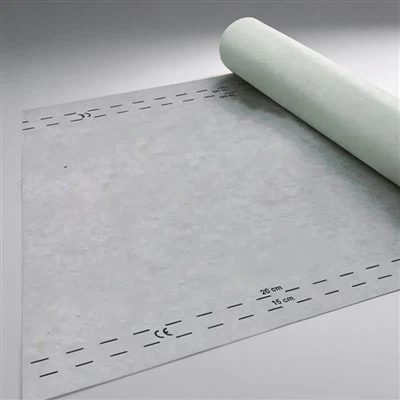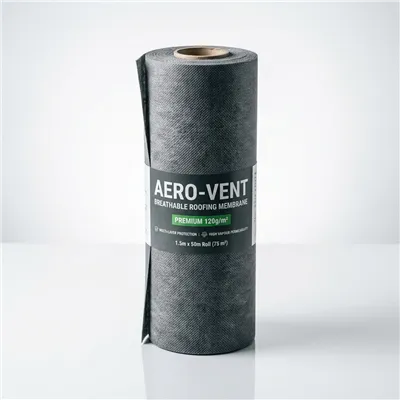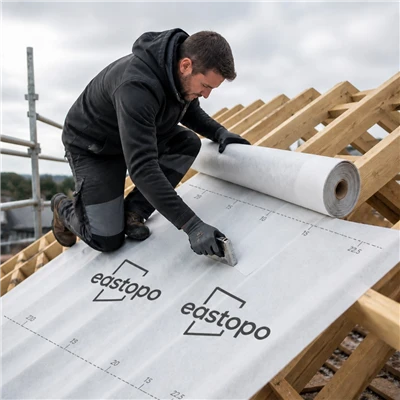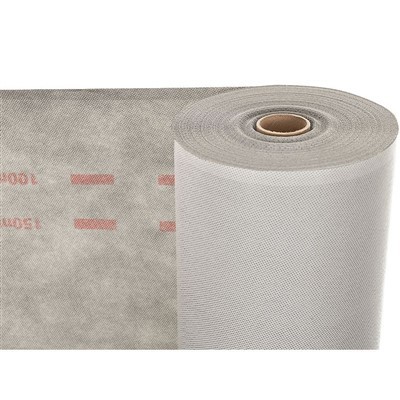


A breathable felt membrane is a vapour-permeable roofing underlay used in place of traditional Type 1F bitumen felt. Our three-layer PP/PE membrane runs from 60 gsm to 220 gsm, is classified Type LR under EN 13859-1, holds Class W1 water tightness, and leaves the factory on 1 m and 1.5 m x 50 m rolls with your own branding printed at the line.
What Is a Breathable Felt Membrane?
The name comes from the product it replaced. For most of the last century a pitched roof in the UK and Ireland was lined with Type 1F bitumen felt - a heavy, reinforced, impermeable sheet laid over the rafters. It kept the rain out and, unfortunately, kept the moisture in. When warm damp air from the rooms below reached the cold underside of that felt, it condensed, and the timber beneath it stayed wet.
A breathable felt membrane keeps the waterproofing and drops the impermeability. It is still a felt-weight underlay that goes on the same rafters, in the same sequence, at a comparable roll size. What changed is the film: vapour passes through it, so the roof structure dries inward instead of rotting in place.
Buyers use three words for the same material - breathable felt membrane, breathable roofing felt, and breather membrane. Specifiers in the UK and Ireland tend to say felt or felt underlay; the US says roofing underlayment or house wrap; Australia and New Zealand say sarking. The classification that matters is the same in all of them: Type LR, low water vapour resistance, tested to EN 13859-1.
Breathable Felt Membrane vs Type 1F Felt
The table below is the comparison a roofer actually needs when quoting a re-roof, using our own EN 13859-1 test data rather than a generic claim.
| Property | Breathable felt membrane (ours) | Type 1F bitumen felt |
|---|---|---|
| Vapour permeability (Sd) | 0.02 - 0.035 m | Effectively impermeable |
| Condensation | Moisture passes out through the membrane | Condenses on the cold underside |
| Timber below | Stays dry | Decay risk builds over the roof's life |
| Water tightness | Class W1 | Watertight but non-breathing |
| Roll weight | 60 - 220 gsm, one-person handling | Heavier and stiffer to lay |
| Ventilation design | Reduced, follow BS 5250 | Full cross-ventilation required |
| UV exposure while open | 3 - 4 months | Shorter, degrades faster |
Nothing in this table says felt was the wrong answer for its time. It was the right answer before roofs were insulated to current standards. Once a roof is insulated, the moisture load behind the lining rises and a non-breathing felt turns into the weak point of the build-up.
Three Layers: PP Outer Films over a PE Microporous Film
A breathable felt membrane has to do two opposite jobs at once: keep liquid water out and let vapour out. Our sheet does it with three films bonded into one. The two outer layers are polypropylene - UV stabilised, and mechanically tough enough to take staples and clout nails without tearing out. Between them sits a PE microporous film produced by cast extrusion and then MDO drawn, which is what opens the vapour path while the pores stay too small for liquid water.
The layers are close to equal in thickness. That matters commercially: roofs are not always covered the same week the membrane goes on, so the outer film has to survive being walked on and weathered while the roof is open. A thin outer skin on a thick middle film is cheaper to make and it is the usual reason a low-cost roll fails on a delayed roof.
Technical Parameters
Every figure below is measured on the breathable felt membrane we ship, using EN 13859-1 test methods, rather than quoted from a reference sheet. Where a property spans a range, the low end is the lightest grade in the standard range and the high end is the heavy duty grade.
| Parameter | Value | Why a buyer checks it |
|---|---|---|
| Underlay type | Type LR (low resistance) | The classification roofing inspectors ask for |
| Vapour permeability (Sd) | 0.02 - 0.035 m | Sets the BS 5250 ventilation allowance |
| Breathability | 2000 - 6000 g/m2/24h | Drying capacity of a new build |
| Tensile strength MD / TD | 120 - 350 N / 80 - 310 N | Wind uplift and installation loads |
| Tear strength | 20 - 40 N | Holds staples and clout nails |
| Water tightness | Class W1 | Full resistance to surface water |
| UV stability | 3 - 4 months | Safe for a delayed covering |
| Standard weight | 60 - 220 gsm | Budget grade through heavy duty |
| Roll formats | 1 m / 1.5 m x 50 m, 100 m lengths | Fits standard merchant shelf and racking |
| Certification | EN 13859-1, ICR-verified | Documentation package for the project file |
Roll Formats Merchants Actually Stock
A breathable felt membrane competes for shelf space with the product it replaces, so the roll size is not a detail. Our standard trade roll is 1.5 m x 50 m. The 1 m x 50 m roll is the one that sells through merchants whose customers are one-van roofers doing a single extension. Where a branch needs a size that fits its own racking, we cut the length and width at the line.
The 50 m roll is the trade default because it maps onto a normal house roof run. Longer 100 m rolls suit contractors sheeting a whole terrace and distributors who buy by the pallet and cut down. Rolls are wound, edge trimmed, weighed, and labelled with production date and batch number, so a branch can trace a pallet back to the line if a customer ever queries it.
If you sell in the UK and Ireland, the shelf word to buy and sell against is felt membrane. If you sell across the EU, breather membrane carries the same product under a name your customers search for.
Which GSM Grade for Which Job
GSM is the first number a trade buyer checks on a breathable felt membrane, and the range from 60 to 220 gsm is not a marketing ladder - each band has a job.
Grades around 60 to 90 gsm suit sheltered sites, temporary cover, and wall applications where the membrane never sees wind uplift. The mid range, roughly 100 to 140 gsm, is the volume seller for pitched domestic roofs and is the grade most merchants hold in depth. From about 150 gsm upward the membrane is specified for exposed sites, high wind zones, and roofs where the covering will be delayed, because the extra mass is what holds the sheet in place against uplift.
Sizing a job is a short conversation: tell us the pitch, the exposure, the covering, and whether the membrane stays open to weather, and we will name the grade rather than send a range.
Certification and Compliance Notes
Our breathable felt membrane range is covered by a voluntary Verification of Conformity issued by ICR Co. Ltd., referencing EN 13859-1:2014 for roof underlays, EN 13859-2:2014 for wall underlays, and EN 13501-1:2018 for reaction to fire. The document is issued on a voluntary basis and we describe it exactly that way - we do not present it as a CE mark, and we do not claim an EC type examination.
We supply the test documentation package with the quotation, whether the buyer needs it for a project file, a tender submission, or a distributor's own technical sheet. Independent laboratory test data is available alongside the conformity document for any property in the table above.
Installation Notes for Roofers
Keep the breathable felt membrane draped, not stretched. A slight sag between rafters lets the sheet drain to the gutter instead of holding a puddle against the timber. Lap horizontal joints in the direction of water flow, and run laps over a rafter so a fixing lands through both sheets.
Counter-battens over the membrane protect it from the tile battens and keep the vapour path open. Where the roof has a valley or a change of pitch, keep the laps continuous through the detail. And if the covering will not go on for months, check the UV exposure limit for the grade you bought - our standard range is rated for three to four months open to weather.
OEM and Private Label Supply
We supply the breathable felt membrane to distributors, merchants, and roof-system brands rather than selling retail. Rolls can be printed with your brand and logo at the line during production, at your choice of gsm, width, and roll length, so the product your customers receive never changes between orders.
Lead time is 25 to 35 days from deposit, depending on the print and the grade mix in the order. Rolls are packed on pallets with edge protection, or shipped loose-packed where that gives a better container load factor. We quote EXW, FOB, CFR, or CIF - tell us which one your costing model uses.
Frequently Asked Questions
Is a breathable felt membrane a direct replacement for Type 1F felt?
Yes, over the same rafters. It is a felt-weight underlay in a comparable roll format, so a roofer lays it with the same sequence and fixings. The difference is that it lets vapour through, which a 1F felt does not, so where the roof is insulated the ventilation design changes in your favour. Because the membrane breathes, many unventilated cold-roof and warm-roof build-ups become buildable without extra vents.
What is the difference between a breathable felt membrane and a breather membrane?
Nothing material - they are two names for the same class of vapour-permeable underlay. Felt is the term that stuck in the UK and Irish trade because it replaced bitumen felt on the same part of the roof. Breather membrane is the term used in technical writing and across the EU. When you compare suppliers, compare the Sd value, the water tightness class, and the roll weight, not the wording on the wrapper.
What GSM felt membrane should I stock?
For a merchant, the 100 to 140 gsm band is the volume seller and the one to hold in depth, because it covers most pitched domestic re-roofs. Add a lighter 60 to 90 gsm roll for wall work and temporary cover, and a 150 gsm plus roll for exposed sites. Stocking all three bands means you can answer the question a roofer asks at the counter instead of sending them to a competitor.
Which roll formats are available?
The standard trade roll is 1.5 m x 50 m, with 1 m x 50 m as the volume format for single-extension work and 100 m lengths for contractors and distributors who cut down from a pallet. Custom widths and lengths are made to order with your print. Tell us the racking dimensions your branch uses and we will work to them rather than to our own default.
How long does a breathable felt membrane last?
As part of the roof build-up, a correctly installed membrane is expected to serve the life of the covering. Two things shorten it: UV exposure while the roof is left open, and mechanical damage from battens laid directly on the sheet. Our standard range is rated for three to four months open to weather - beyond that, cover the roof or fit a grade specified for prolonged exposure.
Can a breathable felt membrane be used on walls as well as roofs?
Yes. The same range is tested against EN 13859-2 for wall underlays, and it is used behind rainscreen cladding, timber frame, and render systems where the wall needs to shed water outward and still dry inward - see house wrap and wall WRB for the wall-specific grades. The grades that work best on a vertical wall are the lighter ones: the sheet does not face the same wind uplift as a roof, so the extra mass buys you nothing there.
Is it waterproof if it lets vapour through?
Yes. Water tightness and vapour permeability are separate properties, and our membrane holds Class W1 water tightness - full resistance to surface water - while still passing vapour. Vapour escapes as individual molecules through micropores that are far smaller than a water droplet, so wind-driven rain and roof run-off cannot pass back through.
Do you supply OEM and private label rolls?
Yes - printed rolls are our normal way of working. Send your brand artwork, the gsm grades you want, and the roll width and length, and we quote from that. Lead time is 25 to 35 days from deposit. We quote EXW, FOB, CFR, or CIF depending on how your costing model is built.
Related Membrane Pages
If your job is more specific than a straight felt replacement, these pages carry the detail:
Breathable Roofing Membrane - the full range specification, wind zones 1 to 5, and grade selection for pitched roofs.
Breathable Roofing Felt and Sarking - the Australian and New Zealand sarking formats of the same three-layer build.
Breathable Loft Membrane - loft lining and loft conversion detailing, including the air gap over insulation.
Breathable Building Membrane - the whole envelope: pitched, cold, warm and unventilated roofs, plus wall build-ups.
Breathable Membrane for Shed Roof - garden buildings, outbuildings and small roof build-ups.
House Wrap and Wall WRB - the lightweight 60 to 90 gsm grades for walls, timber frame and 2.74 m rolls.
About the Author
J. Mao is Export Manager at Hangzhou Eastopo New Materials Technology Co., Ltd., and has supplied membrane, wall panel, and ceiling systems to distributors and contractors across the UK, EU, North America, and Australasia. He works directly with buyers on grade selection, roll format, and project documentation.
Request a Sample Roll
Tell us the grade band, the roll format, and the annual volume, and we will send a sample roll with the test documentation behind it, not a brochure. Email mj@eastopo.com or message +86 193 5725 8106 on WhatsApp with your requirement.
If your project needs a membrane type this page does not cover, tell us what the roof is doing and we will point you to the grade that fits - even when the answer is a lighter roll than you were expecting.
Hot Tags: breathable felt membrane, breathable roofing felt, felt membrane, breather membrane, 1F felt replacement, roofing underlay, Breathable Felt Membrane, Breathable Roof Membrane, Membrane Breathable, Breathable Membrane For Vents, Breathable Membrane For Shed Floor, Breathable Vapour Membrane