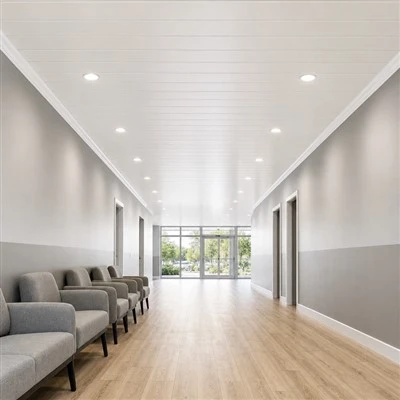
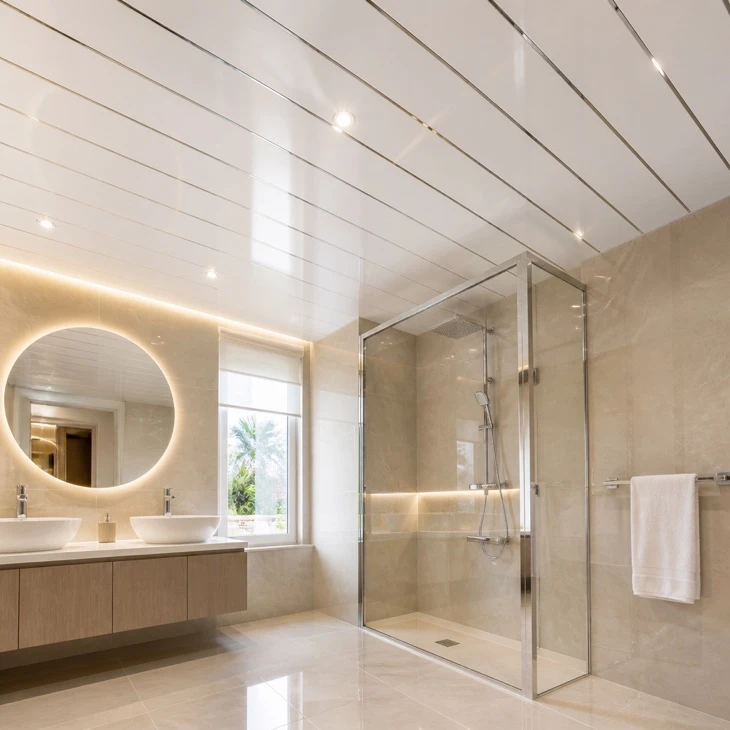


Bathroom Ceiling Panels - Steam, Scrub, Repeat. No Rot. No Paint. No Callback.
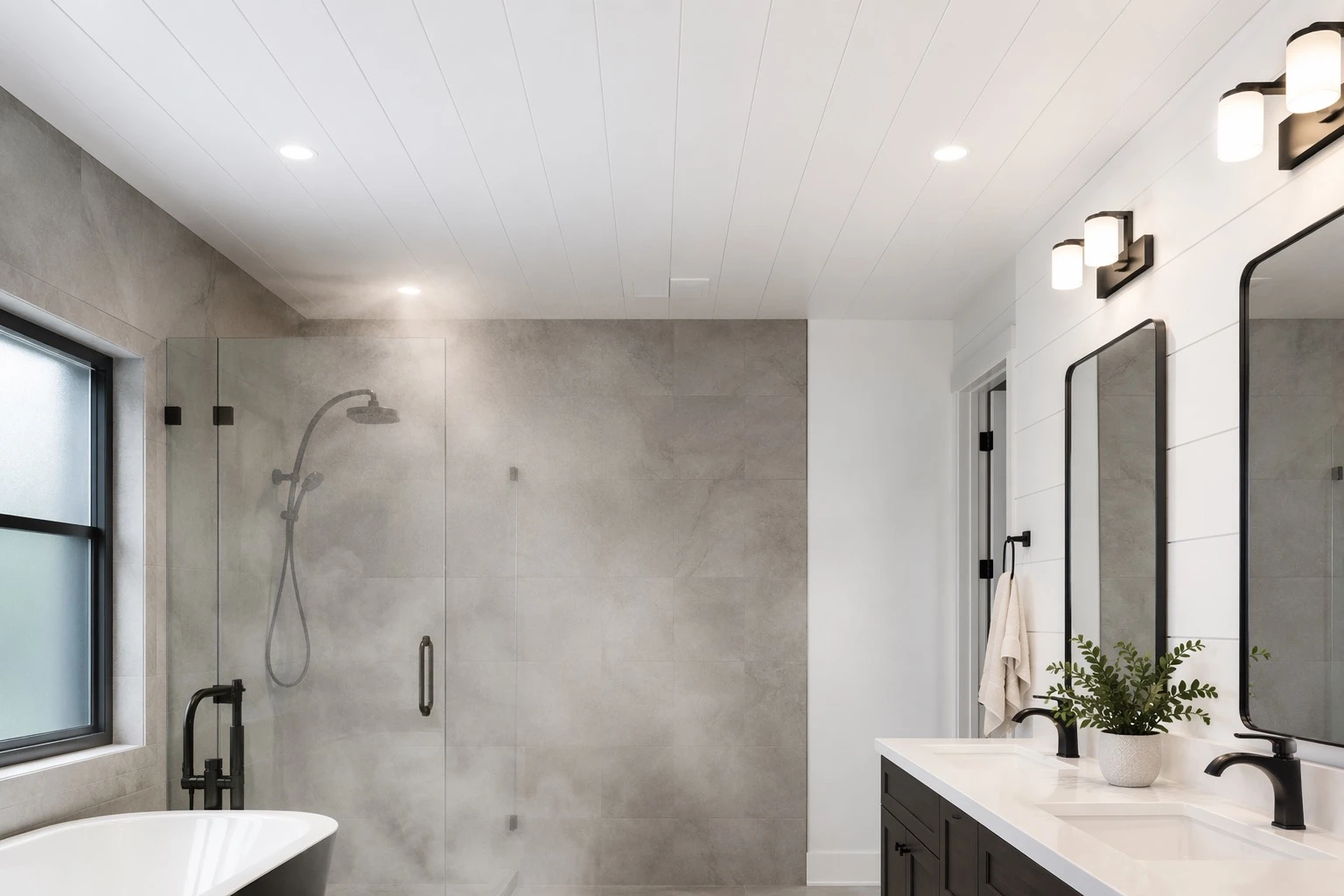
A bathroom ceiling gets more abuse than any other surface in the building. Hot shower steam at 40°C for 20 minutes. Cold ambient air at 18°C the rest of the day. Condensation dripping onto the surface every cycle. Chlorine-based cleaning sprays every week. In a UK social housing block with 80 identical bathrooms, the maintenance log tells the story: gypsum ceilings get repainted every 3–4 years. Mineral fibre tiles get replaced at year 2 when the corner sags from a pipe leak two floors up. Our PVC bathroom ceiling panel gets wiped with a cloth.
This product is a hollow-core PVC extrusion - same die as our standard ceiling panel, same 0.2mm thickness tolerance, same tongue-and-groove edge. The difference is entirely in the spec: 8.0 mm thickness for bathroom wall-direct fixing, B-s2,d0 fire class, calcium-zinc stabilisers with zero formaldehyde. It does not absorb water. It does not feed mould. It does not need painting. A hotel chain with 120 bathroom pods buys 2,400 m² once and the facilities team stops budgeting for ceiling maintenance. That is the arithmetic a general contractor understands.
We extrude these in Haining. Twelve lines. One QC gate at 0.2 mm tolerance. CE certified to EN 13245-2:2008. As the manufacturer we quote wholesale prices direct - no trading-house margin between you and the extrusion line. Distributors in the UK, EU, US, Australia and New Zealand order this same extrusion as bathroom ceiling cladding or wet room ceiling panels - one die, one colour-matched batch. If the job is a multi-unit residential block in Glasgow or a resort refurbishment in the Gulf, you want the ceiling that survives the worst room in the building without a single warranty claim. Full technical parameters at the PVC Ceiling Panel category page.
Why Bathroom Ceilings Fail - And Why PVC Does Not

Moisture Cycling
A bathroom in a family home gets used 3–5 times daily. Each shower dumps roughly 1.5 litres of water into the air as steam. The ceiling absorbs the brunt of it. Gypsum is hygroscopic - it takes on moisture, swells, and releases it slowly. After 500 cycles, the paper facing separates from the gypsum core. After 2,000 cycles, the board sags. PVC is not hygroscopic at all. Water absorption is ≤0.5% after 24 hours of submersion (EN 13245-2 §5.4). The panel does not know whether the bathroom was used three times or three hundred times.
Mould and Bacteria
Gypsum board has a paper facing. Paper is cellulose. Cellulose is mould food. Once the relative humidity in the bathroom exceeds 70% for more than six hours, mould spores germinate on the ceiling surface. The black spots appear at the corners first - the coldest part of the ceiling where condensation sits longest. PVC is 100% synthetic. There is nothing organic for mould to consume. The surface can be cleaned with standard household bleach solution. In healthcare bathrooms, it takes hospital-grade quaternary ammonium disinfectants without surface degradation.
Paint Failure
A painted gypsum bathroom ceiling fails because paint is a film - it sits on top of the substrate. Steam penetrates the paint layer through microscopic pinholes, reaches the paper, and lifts the paint from underneath. Peeling starts at the edges. Within 18 months, the ceiling looks like it has a skin condition. PVC bathroom ceiling panel has no paint layer. The colour is in the compound - titanium dioxide for white, iron oxide pigments for colours. Scratch it and it is the same colour underneath. The UV-cured topcoat is 2H hardness, chemically bonded to the print layer. There is nothing to peel.
Installation - Bathroom-Specific Details
A bathroom ceiling installation has constraints that a living room installation does not. The ceiling height is lower. The room is smaller. There is an extractor fan, a light fitting, and possibly a shower rail penetrating the ceiling plane. The fitter is working around a toilet and a basin. These are not excuses - they are site conditions that the fixing method must handle.
Grid or Direct-Fix?
For a bathroom renovation where the existing ceiling is a level gypsum board in acceptable condition, direct-bond is faster. Apply hybrid polymer adhesive in 200 mm vertical beads, press the panel into place, support for 24 hours until cure. No grid. No lost ceiling height. A 2-man crew closes a standard 2.4 m × 2.4 m bathroom ceiling in 45 minutes.
For new builds where the ceiling height allows, a suspended aluminium grid is preferred. It gives access to the plumbing above - the bathroom stack pipe, the extractor duct. Access hatches can be integrated into the grid for future maintenance. The panel clips in exactly as it does on any other suspended ceiling.
Penetrations - The Extract Fan Problem

Every bathroom has an extractor fan. Cutting a 100 mm hole in a PVC panel is straightforward - hole saw, steady hand, 30 seconds. The problem is the seal. If the fan housing does not sit flush against the panel face, moisture migrates through the gap into the plenum above. Use a closed-cell foam gasket between the fan flange and the panel face. Seal the perimeter with neutral-cure silicone. Do not use acrylic caulk - it shrinks and cracks within 12 months under thermal cycling.
The Light Fitting
Recessed downlights generate heat. An LED downlight housing reaches roughly 45-55°C at the surface. PVC Vicat softening point is 75°C. The clearance is adequate for LED - the panel will not soften. But if the bathroom spec calls for halogen downlights (unlikely in 2026, but it happens on renovation jobs where the electrical is not being upgraded), the housing surface temperature can reach 90°C. That is above the Vicat point. PVC will deform around the fitting. Reject the spec or specify a fire-rated downlight housing with thermal isolation.
Technical Parameters
| Parameter | Value |
|---|---|
| Material | Virgin PVC + calcium-zinc stabilisers. Zero regrind. Zero formaldehyde. |
| Widths | 100 / 150 / 200 / 250 / 300 / 400 / 600 mm (seven OEM widths). Bathroom standard: 250 mm. |
| Lengths | 2,400 / 2,600 / 2,700 / 2,900 / 3,000 mm. Bathroom standard: 2,600–2,700 mm (fits most bathroom ceiling spans without end-joining). |
| Thickness | 8.0 mm recommended for bathroom. Below 7.0 mm - floppy during wall fixing. Above 10.0 mm - unnecessary for suspended grid. |
| Tolerance | Width ±0.5 mm. Thickness ±0.2 mm. |
| Water absorption | ≤0.5% (24h, EN 13245-2). Effectively waterproof. |
| Fire classification | B-s2,d0 (EN 13501-1). Bathroom-acceptable in all UK/EU building codes. Not for protected escape routes requiring A1/A2. |
| Mould resistance | Grade 0 (no growth, ISO 846). Non-organic substrate. No nutrient for mould spores. |
| Chemical resistance | Tolerates: chlorine bleach (5%), quaternary ammonium disinfectants, mild acids (citric, acetic). Avoid: acetone, MEK, toluene. |
| Vicat softening point | ≥75°C (ISO 306). Safe clearance from LED downlight housing (45-55°C). |
| CE certification | EN 13245-2:2008. Certificate SC-PSC-4-2026-06-54. |
Three Ways a Bathroom PVC Ceiling Fails - And How to Prevent Every One

Perimeter seal failure. The panel is waterproof. The joint between the panel edge and the wall tile is not. Water running down the wall hits the tile-to-ceiling junction and sits there. If the L-angle trim was installed without a silicone bead behind it, water wicks into the gap by capillary action. It does not damage the PVC - it damages the substrate behind it. Solution: run a 3 mm neutral-cure silicone bead along the wall before clipping the L-angle trim into place. The trim sits in the silicone, not on dry plaster.
Steam bypass through downlight cutouts. The panel is a vapour barrier. A 70 mm hole for a downlight is a vapour breach. Warm moist air from the bathroom enters the ceiling void through the cutout, condenses on the cold underside of the floor slab above, and drips back down - sometimes through the same hole, sometimes through a different one 3 metres away. The fitter blames the panel. It is not the panel. Each downlight cutout needs a fire-rated vapour seal hood. This is standard practice for any ceiling type - PVC, gypsum, or mineral fibre - but it gets skipped on PVC jobs because fitters assume "waterproof panel = waterproof installation." The panel is waterproof. The hole is not.
Adhesive failure on painted substrates. Direct-bonding PVC to an old painted gypsum ceiling fails because the adhesive bonds to the paint, not the substrate, and the paint delaminates under the weight of the panel. The panel sags. The callout is for "PVC ceiling failure." It is a paint failure. Before direct-bonding to an existing ceiling, test the paint adhesion with a cross-hatch cutter. If the paint lifts, scrape it off or overboard with 6 mm ply. Do not bond to peeling surfaces.
B2B Ordering

Bathroom projects typically batch-order - 50 bathrooms, 300 m², one delivery. We ship single-batch production for projects above 500 m² to guarantee colour match across every bathroom. One site. One container. No colour drift between unit 1 and unit 50. Custom lengths to 5.95 m. 250 mm width is standard bathroom spec - fewer joint lines, faster install, cleaner look. Ordering direct from the manufacturer gives you one quote, one colour-matched batch and one warranty contact - the wholesale price is the factory price.
MOQ, container loading, lead time, shipping, Incoterms, and full trade terms at the PVC Ceiling Panel category page.
FAQ
Can PVC ceiling panels be used directly above a shower? +
Yes. The panel is 100% waterproof. Direct water spray from a shower head does not affect it. The consideration is not the panel - it is the fixing method. If the shower area has a lowered ceiling or bulkhead, ensure the fixing screws are stainless steel (304 grade minimum) and the screw heads are sealed with a dab of silicone. Zinc-plated screws will rust within 18 months in a directly wetted area.
How do I prevent mould growth on the ceiling? +
The PVC panel itself does not support mould - there is nothing organic for spores to consume. Mould appears on PVC ceilings only when dust and soap residue accumulate on the surface over time and provide a nutrient layer. Wipe the ceiling with a damp cloth every 6 months. For bathrooms with known mould problems (poor ventilation, north-facing, cold climate), specify the panel in white satin finish - it makes dust visible before it becomes a mould substrate.
What happens if the bathroom floods from the floor above? +
Water pools on top of the panel in the ceiling void. The panel is waterproof - the water sits there until it either evaporates or finds a path through a penetration (light fitting, extractor fan). Turn off the water supply to the floor above. Drain the pooled water by removing the nearest downlight or access hatch. Dry the void with a dehumidifier for 48 hours. The PVC panel will not warp, stain, or delaminate. Gypsum would need replacing. PVC needs drying.
Can I install PVC ceiling panels over existing tiles? +
Yes. If the wall tiles extend to the ceiling and are soundly fixed, the PVC panel can be direct-bonded onto the tile surface. Clean the tiles with sugar soap to remove grease and soap residue. Score the tile surface with 80-grit sandpaper to provide mechanical key. Apply hybrid polymer adhesive. The bond strength to glazed ceramic tile is adequate at roughly 0.8–1.2 MPa - well above the panel's dead weight of 1.9 kg/m².
Does the ceiling need an extractor fan with PVC panels? +
Yes. Building regulations in most jurisdictions require mechanical ventilation in any room with a bath or shower - regardless of ceiling material. PVC does not exempt the bathroom from ventilation requirements. It does, however, survive longer than gypsum when the extractor fan is undersized or blocked.
Are bathroom ceiling panels a good idea? +
Yes, for any moisture-prone room. A bathroom ceiling panel is 100% waterproof, mould-resistant and wipes clean with a damp cloth - which is why specifiers use them for shower rooms, wet rooms and family bathrooms instead of repainting gypsum every 3-4 years. Pair the panel with an extractor fan and silicone-sealed penetrations and it outlasts the building services around it.
What type of ceiling is best for a bathroom? +
For a bathroom, a waterproof panel ceiling beats gypsum, mineral fibre and painted plaster. Gypsum and mineral fibre absorb steam and sag or stain within 2-3 years. A PVC ceiling panel is non-absorbent (water absorption ≤0.5% to EN 13245-2 §5.4), mould-grade 0, and rated B-s2,d0 for fire. It installs by direct-bond or suspended grid and wipes clean. That is why specifiers choose PVC panels for shower rooms, wet rooms and family bathrooms.
Is cladding good for a bathroom ceiling? +
Yes. Ceiling cladding - PVC or plastic panels - creates a fully waterproof barrier, stops peeling paint, and covers old cracks or stains without plaster repair. The panel is 100% synthetic, so there is no organic surface for mould, and it withstands chlorine bleach and quaternary ammonium disinfectants used in wet areas. For a contractor, cladding a bathroom ceiling means one clean visit instead of a repaint every 3-4 years.
About the Author
Written by J. Mao - Export Manager, Eastopo New Materials (Hangzhou, China). J. Mao works with distributors and contractors on PVC wall and ceiling panel specifications, certification documentation and container planning. For project questions, email mj@eastopo.com or WhatsApp +86 193 5725 8106.
Send us the bathroom count and floor plan. We return a single-batch factory quote with trim, adhesive, and delivery. For hotel and multi-unit projects, ask for a per-unit cost breakdown and a sample installation mock-up before container commitment.
Hot Tags: pvc bathroom ceiling panels, bathroom ceiling panels, bathroom ceiling cladding, wet room ceiling panels, wholesale bathroom ceiling panels, Plastic Wood Ceiling Panel, Joining PVC Ceiling Panel, PVC Interlocking Ceiling Panel, PVC Ceiling Flat Panel, PVC Wood Ceiling Panel, Plastic Sheet Ceiling Panel