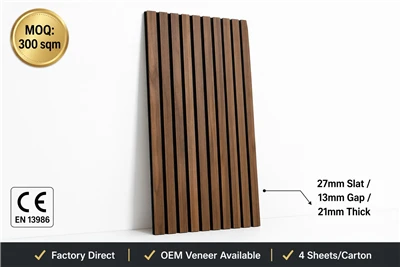


Bamboo Fiber Carbon Panel: The Name and the Product
"Bamboo fiber carbon panel" is the market term international buyers use for a specific family of PVC interior wall panels made by Chinese factories. The name travels well in trade shows, search results and procurement lists, but it describes a market category, not an ingredient list. Before you compare quotes, it pays to know exactly what sits inside the panel.
The panel Eastopo manufactures under this name is a PVC hollow core wall panel: two extruded PVC skins with parallel rectangular channels between them, a tongue-and-groove edge, and a laminated decorative film sealed under a UV-cured topcoat. There is no bamboo fibre content and no carbon additive in the compound. The extrusion is a controlled PVC compound. That is what arrives in your container, and it is what the batch certificate documents.
Why does the name persist? Because a bamboo fiber carbon panel, as searched by distributors and contractors when they compare wall panel manufacturers, means one thing: a light, waterproof, wood-grain finished PVC wall board that a two-man crew can install in a day. The market word describes the promise, and the hollow core construction delivers it. We keep the name because that is how the trade finds us, and we publish the real specification because that is how the trade keeps us.
Who searches this term? Distributors stocking interior wall finishes in the UK and EU, contractors quoting commercial fit-outs in the US, and importers building a PVC panel range for Australia and New Zealand. They all land on the same page: a factory that can ship a container of wood-grain wall panels with certificates, not a trader who ships photos. The term is searched because it is the category shorthand; the buying decision happens on specification, lead time and price per square metre.
Inside the Panel: PVC Hollow Core Construction
Take a bamboo fiber carbon panel from Eastopo and cut it across the width. What you see is a row of parallel rectangular channels separated by thin extruded ribs, capped by smooth PVC skins top and bottom. This is a hollow core profile, and every property buyers care about flows from it.
The channels make the panel light: one sheet is easy for a single fitter to carry, lift and cut, which keeps site labour down. The ribs make it rigid: the geometry resists bending and torsion far better than a flat sheet of the same weight. And because the profile is extruded as one piece, the panel stays dimensionally stable when humidity climbs - no swelling, no warping, no cupping at the seams. The tongue-and-groove edges lock adjacent sheets together and hide the fixing points, so a wall reads as one clean surface.

What Buyers Searching "Bamboo Fiber Carbon Panel" Actually Get
Search the term and you will find a handful of Chinese wall panel manufacturers ranking for it - the same handful our own research team monitors. Wholesale buyers shortlist from that handful, so the page has to do two jobs: rank for the term and prove the factory behind it. The prices look similar. The photos look similar. The panels do not have to be.
Four things separate a serious bamboo fiber carbon panel factory from a trader with a website. First, the wall thickness of the skin and ribs - thin walls save resin but dent and telegraph under load. Second, the decorative film: bonded films stay flat for years; cheap films lift at the T&G edges within months. Third, the QC trail: batch numbers, thickness readings, water absorption tests you can ask for by name. Fourth, the certificate: a real CE EN 13245-2 file, not a logo pasted into a banner. Ask for all four before you ask for a price.
Wall thickness deserves a closer look because it is invisible in photographs. A panel skin and rib thickness below 1 mm saves resin, which is how some suppliers hit a low price. It also dents when a trolley catches the wall and telegraphs stud lines after a year of temperature cycles. Ask for the wall thickness in writing, and cut a sample before you commit a container. A serious factory quotes a number; a reseller quotes a photo.
Film quality is the second invisible. Decorative films are bonded in a lamination line, and the bond is only as good as the surface preparation and the adhesive. Our line tests peel resistance on every shift, because the failure that reaches a buyer is always the one that happened at the glue line. When you compare factories, ask what the film adhesion test is and how often it runs. If the answer is a shrug, the panel is a gamble.
Finishes and Decorative Films
The finish is what sells the panel to the end client, so it deserves scrutiny. Eastopo laminates decorative PVC films onto the panel face, then seals them with a UV-cured topcoat at 2H pencil hardness or better. The topcoat is what stops scuffs, stains and yellowing in real rooms.
The film range covers light oak, walnut, grey oak and other wood grains, plus plain colours for feature walls and ceilings. Grain direction runs with the panel length, so a row of panels produces one continuous wood look. Film adhesion is checked before a batch is released - the failure mode buyers fear most is a film that lifts at the joint, and it is the failure we test against.

Technical Specification: PVC Hollow Core Panel
The specification below is what Eastopo quotes for the bamboo fiber carbon panel range. It is the same data we send with samples and the same data printed on the batch certificate. If a supplier's data sheet cannot answer these lines, treat the quote as incomplete.
| Feature | Specification | Notes |
| Structure | PVC hollow core, parallel rectangular channels | Tongue-and-groove edges |
| Panel widths | 400 mm / 600 mm | Stock width for wall panels |
| OEM widths | 400 mm / 600 mm | Same two widths on custom runs |
| Lengths | 2400 / 2700 / 3000 mm | Cut to order available |
| Thickness | 8 mm / 9 mm | Two thicknesses; 9 mm for high-traffic walls |
| Weight | 3.5 - 4.2 kg/m² (8 mm); 4.0 - 4.5 kg/m² (9 mm) | By thickness |
| Surface | UV-cured topcoat (≥2H) + laminated decorative film | Wood-grain and plain finishes |
| Water absorption | ≤ 0.5% | EN 13245-2 Section 5.4 |
| Fire classification | EN 13501-1 Class B-s2,d0 | Interior wall and ceiling use |
Two specification notes worth reading twice. First, water absorption is tested at ≤ 0.5% to EN 13245-2 Section 5.4 - some data sheets in the market print a lower figure by mistake; our batch certificates carry the tested value. Second, the panel carries EN 13501-1 Class B-s2,d0, the classification referenced for interior wall surfaces in the EU and UK. Ask your supplier for the test report, not just the claim.
Quality Control: What a Factory Check Covers
A bamboo fiber carbon panel quote is only as good as the QC that sits behind it. Eastopo runs the panel range through a fixed inspection sequence: incoming compound checks, extrusion profile gauging, film adhesion testing, thickness sampling on the line, and water absorption tests on finished batches. Every batch ships with a certificate that carries the batch number and the tested values.
For buyers comparing factories, the practical question is simple: can the supplier name its test methods and show records? We can, because the tests are on the line, not in a brochure. That is the difference between a wall panel factory and a wall panel reseller.

MOQ, Lead Time and Incoterms for First Orders
The ordering basics for the bamboo fiber carbon panel range are set so a first trial order is realistic and a container order is easy. Eastopo is a wall panel manufacturer, not a trading desk: the range runs out of the Haining facility, where 36 extrusion lines across the factory cover PVC wall and ceiling panels, acoustic panels and roofing membranes, with a combined monthly PVC panel capacity of 600,000-800,000 m², so a distributor can order a private-label finish without starving the stock lines. The full PVC wall panel range is listed on the category page.
MOQ
The minimum order is 500 m² per colour and finish. That is roughly the quantity a distributor needs to test a market before committing to a container, and small enough that a contractor can trial the panel on one job.
Lead time
Stock colours and finishes ship in 18 - 22 days. Custom films, private-label packaging and mixed-container planning run 28 - 35 days. Lead time is quoted per order and confirmed in writing, not estimated.
Incoterms
We quote EXW, FOB, CFR and CIF. That is the full list - no other delivery terms are offered, because these four keep the price comparison clean and the shipping risk allocated in a way both sides can verify.
Container Loading and Export Packaging
Export packaging decides whether a container of wall panels arrives as product or as scrap, and it is the part of the order that never makes it into the brochure.
Panels are packed vertically, one carton per width, with edge protectors at the T&G ends and stretch wrap around each bundle. Loaded panel-on-edge into a 20 ft or 40 ft container, a full load carries between 7,000 and 9,000 m² depending on thickness and width mix. Mixed orders - several finishes in one container - are planned at order confirmation so the loading plan is agreed before production starts, not discovered at the dock.
Carton size follows panel width, so a 400 mm or 600 mm panel ships in a carton that fits the standard pallet grid with no overhang - the detail that stops forklift tears at the warehouse. Each carton carries the finish code, quantity and batch number printed on the outside, so a mixed container can be sorted at the receiving dock without opening every box. Moisture barrier film lines the carton interior for sea freight, and the stretch wrap is applied to the whole pallet, not just the top layers.
Loading plans matter more than buyers expect. A full 20 ft container carries roughly 7,000 m² of 8 mm panels; a 40 ft container roughly 9,000 m² - exact figures depend on the width mix and packaging. We confirm the loading plan at order confirmation, so the container utilisation is agreed before production, not discovered at the dock. If your project needs a partial load, we quote the shortfall honestly instead of padding the count.
Installation and Fixing for Commercial Jobs
The T&G profile does most of the alignment work, which is why fitters who have used hollow core panels once rarely go back to cutting-and-fitting.
Preparation
Substrates should be flat, dry and free of loose paint. Panels need 24 hours to acclimatise in the room before fixing; the hollow core profile is stable, but the film and the compound both prefer the room temperature they will live at.
Fixing
Use a solvent-free construction adhesive on smooth clean walls, or screw through the tongue at every third rib into timber studs or metal framing. Heavy items - mirrors, shelves, appliances - must be fixed into the wall structure behind the panel, never into the panel alone.
Trimming
Cut with a fine-tooth blade and score the film side first to avoid chipping. Matching trim profiles finish the corners, edges and reveals, so the last panel looks as deliberate as the first.

Maintenance after installation is where hollow core panels earn their keep versus timber. The UV-cured surface wipes clean with a damp cloth and a mild detergent; it does not need sanding, sealing or re-finishing. Scratches that do appear are in the film, not the panel, and a damaged sheet can be cut out and replaced without disturbing the neighbouring panels - the T&G joint makes the swap a single-sheet job. For facility managers counting maintenance hours per square metre, that is the line that matters.
Certifications and Compliance Documentation
Certification is the difference between a wall panel you can specify and one you can only sell. Eastopo holds CE EN 13245-2:2008, certificate number SC-PSC-4-2026-06-54, covering the PVC panel range. Fire performance is documented to EN 13501-1 Class B-s2,d0.
Certificates, test reports and batch certificates are provided with every order - including wholesale orders that ship under your own label. If your project needs a specific document for a tender file, send the list and we will confirm what can be provided before you order - not after.
Tender documentation is the same story with different paperwork. When a fit-out contractor needs a CE declaration or a fire classification report for a project file, the documents must exist before the order, not after. We keep the current versions on file and provide them with the quotation, so your tender does not stall waiting for a supplier to rediscover its own certificates.
Hollow Core vs. WPC vs. Solid PVC vs. Timber: A Comparison Table
The panel type is only half the decision; the other half is what it is compared against. This table is the comparison we walk buyers through when they are weighing a bamboo fiber carbon panel against the alternatives on the market.
| Factor | PVC hollow core | WPC panels | Solid PVC board | Timber panelling |
| Moisture stability | ≤ 0.5% absorption, no warp | Moisture-resistant, heavier | Waterproof | Swells and cups |
| Weight per sheet | 3.5 - 4.5 kg/m² by thickness | Heavy solid profile | Heavier than hollow core | Heavy, two-man handling |
| Impact resistance | Rigid rib structure | Dense and tough | Rigid | Dents and splits |
| Fire class | EN 13501-1 B-s2,d0 | Varies by formulation | Varies by compound | Varies by species |
| Indoor air & odour | Sealed PVC face, wipe-clean | Varies with formulation | Varies with formulation | Varies with coatings |
| Install time | Fast, T&G, one-man sheets | Heavier, slower | Moderate | Slow, skilled labour |
| OEM customisation | 2 widths, private label | Limited widths | Limited | Limited to stock |
| Cost per installed m² | Lower, faster to fit | Higher material | Mid material | Higher material and labour |
WPC has its jobs - exterior-rated cladding where a denser profile is preferred. Solid PVC board suits surfaces that take repeated heavy impact. Timber remains the choice for projects where a natural finish is the brief. For interior walls that face water, carts and cleaning chemicals, the hollow core panel wins on installed cost, speed and stability. The comparison is not a marketing trick; it is the risk register we use when buyers ask which panel to put where.

FAQ
1. What is a bamboo fiber carbon panel? +
It is the market name for PVC hollow core wall panels made in China: two PVC skins with parallel rectangular channels between them, a tongue-and-groove edge and a laminated wood-grain film under a UV-cured topcoat. The name describes a product category, not an ingredient list.
2. Does the panel contain real bamboo fiber or carbon? +
No. It is a PVC hollow core panel with a laminated wood-grain film. "Bamboo fiber carbon panel" is the established market term for this type of PVC wall panel; the name does not describe the material composition. The batch certificate documents the actual compound.
3. What finishes are available? +
Laminated decorative films in light oak, walnut, grey oak and other wood grains, plus plain colours. Every finish is sealed with a UV-cured topcoat at 2H pencil hardness or better, so the surface resists scuffs, stains and yellowing.
4. Is it suitable for bathrooms and wet areas? +
Yes. Water absorption is ≤ 0.5% to EN 13245-2 Section 5.4, so the panel does not swell or warp in humidity. In showers and splash zones, seal the joints and corners with matching trim.
5. What fire rating does it carry? +
EN 13501-1 Class B-s2,d0, the classification referenced for interior wall and ceiling surfaces in the EU and UK. The test report is provided with the order documentation.
6. What sizes and widths can I order? +
Panel widths are 400 mm and 600 mm; lengths 2400, 2700 and 3000 mm; thickness 8 mm or 9 mm. Custom films, shade numbers and private-label packaging are quoted per order.
7. What is the MOQ and lead time? +
MOQ is 500 m² per colour and finish. Stock finishes ship in 18 - 22 days; custom films, private-label packaging and mixed-container planning run 28 - 35 days.
8. How are the panels fixed? +
Solvent-free construction adhesive on smooth clean walls, or screw through the tongue at every third rib into timber studs or metal framing. Heavy items fix into the wall structure behind the panel.
9. Can I get private-label packaging and custom films? +
Yes. OEM orders cover private-label cartons, custom films, shade numbers and mixed-container planning. Lead time for OEM runs is 28 - 35 days and the loading plan is agreed at order confirmation.
10. What incoterms do you ship on? +
EXW, FOB, CFR and CIF only. These four keep price comparison clean and shipping risk allocated in a verifiable way; no other delivery terms are offered.
About the Author
Written by J. Mao, Export Manager at Hangzhou Eastopo New Materials Technology Co., Ltd. J. Mao has spent a decade in building materials export, specifying PVC wall and ceiling systems for distributors, contractors and interior fit-out companies across the UK, Europe, the US, Australia and New Zealand.
Questions about the bamboo fiber carbon panel range, samples or batch documentation: email mj@eastopo.com or WhatsApp +86 193 5725 8106. Visit our company profile at eastopo.com/about-us.
Ready to compare factories? Send us your widths, lengths, finish and quantity - we reply with a specification-matched quotation within one working day. Get a quotation or email mj@eastopo.com.
Hot Tags: bamboo fiber carbon panel, bamboo fiber carbon panel manufacturer, pvc hollow core wall panel, wall panel manufacturer, wall panel factory, Bamboo Wall Panels Indoor, brick panels interior, interior decorative wall panels, Interior Decor Cladding Wood Grain, modern panelling, interior wall cladding for living room