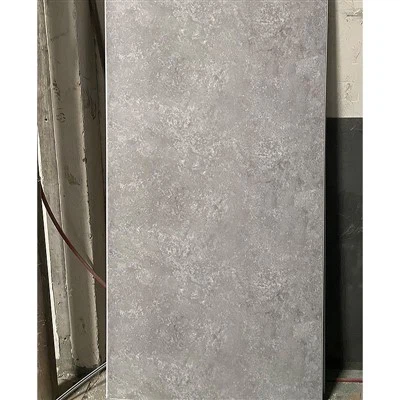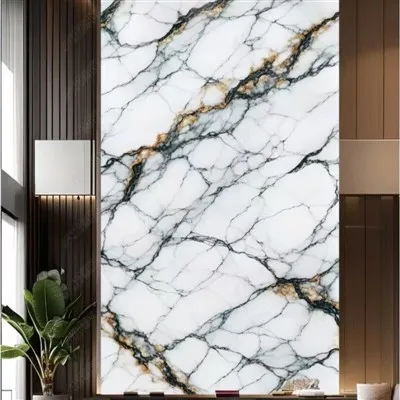


What Is a UV PVC Marble Sheet?
A UV PVC marble sheet is a solid-core PVC wall panel with a printed marble pattern sealed under an ultraviolet-cured resin layer. Contractors and distributors specify it in place of tiles or natural stone when a project needs the look of marble at a fraction of the weight, cost and installation time. The same material family covers pvc marble sheet, uv marble sheet and marble effect wall panels, and the differences between cheap boards and factory-grade boards show up on site, not in the brochure.
The manufacturing sequence is short but unforgiving: the solid PVC core is extruded first, the veining pattern is printed onto it, and a liquid UV resin is applied and cured under ultraviolet lamps into a hard transparent shell. Every one of those three steps has a budget version, and every budget version fails differently. A quality 3D uv marble sheet keeps all three layers honest, which is why it survives transport, cutting, screw fixing and years of cleaning without turning yellow or going dull.
As a buyer, what you are actually paying for is core quality, print fidelity and coating thickness. These three decide whether a sheet looks right on the wall and stays right for the life of the job. This page covers the specification, the failure modes, and the OEM process, so you can compare sheets on facts rather than finish names.
UV PVC Marble Sheet vs Natural Marble vs Porcelain Tile
Choosing between a UV PVC marble sheet, natural marble and porcelain tile comes down to installed cost, schedule and maintenance. For interior walls, the PVC sheet delivers the marble look with a fraction of the weight, a fraction of the installation time and no sealing or grout maintenance.
| Comparison | UV PVC Marble Sheet | Natural Marble | Porcelain Tile |
| Weight | Lightweight, one-person handling | Heavy, structural substrate required | Heavy, adds wall load |
| Installed cost | Lower, factory-direct pricing | High material plus fabrication | Moderate, plus fixing materials |
| Installation time | Hours, adhesive and trim system | Days, specialist cutting and fixing | Days, adhesive, grouting and curing |
| Water resistance | Fully waterproof | Needs sealing, prone to staining | Waterproof, grout lines need care |
| Maintenance | Wipe clean, no sealing | Periodic sealing and polishing | Grout cleaning and re-sealing |
| Surface finish | Continuous panels, minimal joints | Natural veining, slab joints | Multiple grout lines |
| Pattern control | Book-matched, custom colours | Natural variation, limited selection | Fixed factory patterns |

Why Blend Quality Beats High-Filler Boards
Many budget marble boards are formulated with 40-60% calcium carbonate filler. Filler cuts resin cost, but it changes how the board behaves on site. High-filler sheets feel brittle when you cut them, the edges crumble instead of shearing clean, and a screw driven near the edge can split the board. Fitters notice this within the first sheet.
Our sheets are extruded from a controlled blend of virgin and screened recycled PVC with eco-friendly calcium-zinc stabilisers, no lead and no cadmium. The recycled portion is screened at intake for consistency, so the board keeps a dense, uniform cross-section with real screw-holding strength and impact resistance. What ruins a board is poorly screened recycled content mixed into a heavily filled formula, not recycling itself; a controlled blend holds its edge, its colour and its odour profile the way a structural panel should. The solid 2.0-5.0mm core is a structural panel, not a printed skin over foam.
There is a simple site test a fitter can run in thirty seconds. Cut a corner off the sheet and look at the cross-section. A high-filler board shows a chalky, powdery face that dusts under a knife blade, and a board with unscreened recycled content often shows flecks or streaks in the same cut. A well-blended sheet cuts clean, with a smooth even section across the full thickness. Specify the blend quality and the transport damage claims disappear from your project log.

The UV-Cured Surface: Hardness, Scratch Resistance and Colour Stability
The UV layer is what separates a marble sheet from a printed plastic sheet. A liquid UV resin is roller-applied and cured under ultraviolet lamps, cross-linking into a hard film that reaches 2H pencil hardness on the standard scale. The coating is part of the sheet, not a film laminated on top, so it does not peel, bubble or lift at the edges the way PVC film surfaces can.
That hardened surface carries most of the maintenance story. Scratches from daily use, cleaning abrasives, trolleys in hotel corridors and displays in retail fit-outs stay off the pattern. The resin shell also resists the yellowing that cheap clear coats develop under strong lighting, and it shrugs off the dilute cleaning chemicals used in bathrooms and kitchens. A damp wipe is enough; there is no sealing, polishing or waxing program the way natural marble demands.
For a building owner the arithmetic is simple. Natural marble needs periodic sealing and specialist care, and a chipped tile is a visible repair. A UV marble sheet keeps its appearance with the same cleaning routine as the rest of the wall, which is why facility teams specify it for high-traffic interiors.

Marble Effect Finishes and Print Technology
The marble pattern is printed, and print technology decides how convincing the veining looks. High-definition digital printing reproduces the fine veins, soft colour transitions and crystalline highlights of classic stones, from Carrara White and Calacatta to Nero Marquina and Emperador brown. A textured layer adds the tactile depth of real stone, which flat printed panels cannot deliver.
Finish options cover high-gloss for a polished-stone look and matte for a honed, modern feel. Both are available across the standard sheet range, and both carry the same UV-cured topcoat. Pattern continuity matters for large surfaces: the veining should flow across sheet boundaries, so specify bookmatched or continuous-pattern runs for feature walls where the joints are visible.
For OEM buyers the finish library is a starting point, not a limit. Custom patterns, brand-specific colours and Pantone-matched backgrounds can be developed against a sample or drawing, and production is locked to an approved master sample so the batch you receive matches the batch you approved. This is covered in detail under OEM Supply below.

Technical Specifications
The table below covers the standard range. All dimensions and performance figures are from the factory specification sheet and apply to the standard production range.
| Feature | Specification | Core Benefits |
| Dimensions | Width: 122 cm | Standard large-format sizes minimize seams and maximize coverage efficiency. |
| Length: 244 cm / 260 cm / 290 cm | ||
| Structure & Thickness | 2.0mm – 5.0mm Solid Core Options | Flexible adaptation for various scenarios; high impact resistance and superior screw-holding strength. |
| Material Composition | Virgin + Screened Recycled PVC Blend, Eco-friendly Calcium-Zinc Stabilizers | Controlled blend with no lead or cadmium; screened recycled content keeps the board dense, uniform and odour-free. |
| Surface Finish | UV-Cured Protective Layer (≥2H Hardness) | Scratch-resistant, anti-yellowing, and stain-repellent for lasting beauty. |
| Waterproof Performance | Water Absorption ≤ 0.5% (EN 13245-2 §5.4) | 100% suitable for showers, pools, and all high-humidity zones. |
| Safety & Eco-Friendliness | Green & Healthy Material | Non-toxic, odorless, with undetectable formaldehyde; creates a secure living environment. |
| Installation System | Dedicated Aluminum Alloy Trim Profiles | Exquisite finishing, seamless joints, and an elevated overall aesthetic. |
| Application Scope | Universal Indoor Spaces | Perfect for living room feature walls, bedrooms, kitchens, bathrooms, commercial showrooms, and offices. |
Standard stock covers the 2440mm and 2600mm lengths, with 2900mm available for larger runs. Batch consistency is controlled at the extrusion line and the print line, so pattern and colour are locked per production batch. Production is CE certified to EN 13245-2, covering the solid-core sheet line from compound to finished panel. If your project needs a specific length or a non-standard thickness within the 2.0-5.0mm range, confirm it with the export team before ordering; the sheet is supplied flat, wrapped and palletised to survive sea freight.


Installing Marble Effect Sheets on Walls and Ceilings
Installation is where the sheet earns its place against tiles. The substrate needs to be flat, dry and dust-free, but it does not need to be perfect: the large-format sheet bridges minor surface irregularities that would show through individual tiles. Existing ceramic tiles, painted plaster and old panelling can all be over-clad directly, which makes marble sheets a fast upgrade route for renovation jobs.
Cutting is straightforward with a circular saw, a jigsaw or a score-and-snap cutter, and the solid core produces clean edges without the crumbling that high-filler boards show. The sheet is fixed with structural adhesive and, where the spec demands mechanical security, screws or pins through the face, with the holes covered by trim.
Corners, edges and expansion junctions are finished with dedicated aluminium alloy trim profiles. The trim system is what separates a professional marble-panel job from a DIY one: internal and external corners, window returns and base junctions all get a crisp metal line instead of a caulked gap. For a typical bathroom, the wall finish goes up in a day or two against a tiled wall that needs curing time before grouting, which is the schedule argument that wins most contractor reviews.

Best Applications: Hospitality, Retail and Residential
Hospitality projects use marble sheets where the visual needs to carry brand value without a maintenance budget to match. Hotel lobby feature walls, lift lobbies, corridor panelling and restaurant backdrop walls all benefit from a continuous stone look that wipes clean and does not need re-sealing between guest seasons.
Retail and commercial fit-outs use them for display walls, reception desks, showroom backgrounds and office feature panels. The fast install time matters on shopfit programmes where the opening date is fixed, and the replaceability of a single damaged sheet beats replacing a run of tiles.
Residential applications cover the obvious feature wall behind the TV, bathroom walls and shower enclosures, kitchen splashbacks and hallway panelling. A single pvc marble wall panel behind the television or a full-height bathroom wrap uses the same factory stock, the same trim system and the same fixing routine. Because the sheets are fully waterproof and unaffected by humidity, they also work in utility rooms and cloakrooms where wallpaper or painted plaster would fail. Architects value the zero-grout surface: no joints for mould to colonise in wet areas.
Where a UV Marble Sheet Is the Wrong Call
Honest specifications need boundaries, and marble sheets have them. Exterior elevations and surfaces in permanent direct sunlight need a UV-stabilised formulation; confirm the grade with the factory before specifying, because standard interior sheets are not engineered for years of outdoor exposure.
The sheets are wall panels, not load-bearing worktops. A 2-5mm panel is not a kitchen counter or a shelf surface, and heavy point loads will mark it. If the design calls for a marble-look worktop, the sheet belongs on the wall above it, not under the kettle.
Curved or arched surfaces need a thermoforming capability that standard flat sheets do not have. A solid PVC sheet does not cold-bend around a radius, so plan curved soffits or barrel vaults with the factory before the design is tendered. And in public buildings with strict fire classifications, verify the fire rating of the specified grade against the project specification before installation; not every project accepts the same classification.
What Happens When a Cheap Marble Board Fails
The failure modes of budget marble boards are predictable, and knowing them is the fastest way to avoid them. Transport damage is the first: high-filler sheets arrive with broken corners and hairline cracks that only appear after the pallet is unwrapped. The second is yellowing, when a thin or poorly formulated clear coat goes amber within a year under lighting or humidity.
Batch colour drift is the third and most expensive failure. When the print line is not locked to an approved master, the second shipment arrives with different veining density or a shifted background tone, and a wall already installed has to be stripped or blended. The fourth failure is bubbling: a cheap surface layer separates from the core in wet areas as moisture works in behind it.
Use a five-point incoming inspection on the first pallet: cut a corner and check the cross-section is clean and uniform; flex a sample to confirm it returns without creasing; scratch the surface with a coin to confirm the UV layer is hard; lay two sheets side by side and compare pattern and colour across the batch; and measure the thickness at several points against the spec. Any of these failing is grounds to reject the lot before it reaches site.
OEM Supply: Custom Colours, Sizes and Private Label
Our marble sheet line runs as a factory-direct OEM programme for distributors, importers and fit-out contractors. Custom work covers pattern and colour development against a sample or drawing, surface finish selection, lengths within the 2440-2900mm range, packaging to your logistics standard, and private-label branding on the sheet backer and packaging.
The process is sample-first. You send the pattern, the Pantone reference or a physical sample; we develop the print and coating to an approved master; production is then locked to that master so repeat orders match. For stock colours the master already exists, which shortens the lead time considerably.
Consistency across repeat orders is managed at the line level: the same extrusion and print settings are held for your SKU, and batch records are kept against every production run. The MOQ is 500 sqm per colour and finish, and lead times run 18-22 days for stock finishes and 28-35 days for custom development, quoted against order volume. Trading terms are EXW, FOB, CFR or CIF. If you are stocking a warehouse or tendering a phased project, tell us the forecast quantity and we will plan the production slots around it.
If you are fitting out a hotel lobby or stocking a distributor warehouse, send us the pattern and the quantity. We reply with a factory price and a production schedule within one working day.
FAQ
How much does a PVC marble sheet cost? +
Prices depend on thickness, size and order volume. A 3mm solid-core UV marble sheet in a standard size is a small fraction of the cost of natural marble slabs or porcelain tiles once finishing and installation labour are included, and factory-direct pricing improves further at container volumes. Request a quotation with the sheet size, finish and quantity to get an exact figure.
What are the disadvantages of PVC marble sheets? +
PVC marble sheets are wall panels, not load-bearing surfaces, so they are not suitable for worktops or shelving under heavy loads. Standard interior grades are not engineered for exterior use or permanent direct sunlight without a UV-stabilised formulation. Curved installations need thermoforming, and public buildings with strict fire classifications must verify the grade against the project specification.
How long does a PVC UV marble sheet last? +
The service life of a solid-core UV marble sheet is measured in decades for interior applications, provided the core is a well-blended PVC compound and the UV coating is properly cured. The resin layer protects the printed pattern from yellowing and scratches, and because the sheet is fully waterproof, it does not rot or swell in wet areas. Cheap high-filler boards fail far sooner through cracking and yellowing.
Can you use a PVC marble sheet in a bathroom? +
Yes. A UV PVC marble sheet is fully waterproof with water absorption of 0.5% or less, so it is suitable for shower enclosures, bathroom walls and other high-humidity zones. The zero-grout surface leaves no joints for mould to colonise, and the UV-cured topcoat wipes clean with standard bathroom cleaners. Fixing and trimming must follow the manufacturer guidance to keep water out of the wall behind the sheet.
What is the difference between a UV marble sheet and a standard printed PVC panel? +
A UV marble sheet carries a liquid resin layer that is cured under ultraviolet lamps into a hard transparent shell over the printed pattern. Standard printed PVC panels rely on a decorative film that can scratch, fade or lift at the edges. The UV layer adds pencil hardness of 2H or better, resists yellowing and stains, and protects the pattern for the life of the panel.
Is a UV PVC marble sheet better than real marble? +
For interior walls, usually yes on cost, schedule and maintenance: a UV PVC marble sheet weighs a fraction of natural stone, installs in hours rather than days, needs no sealing or polishing and is fully waterproof. Natural marble wins where the owner insists on authentic stone veining and accepts higher material cost, structural loading and periodic maintenance. Most feature-wall and bathroom projects choose the PVC sheet for the same visual effect at a fraction of the installed cost.
Can I order custom marble patterns and sizes for an OEM project? +
Yes. OEM orders cover custom pattern and colour development against a sample or drawing, surface finish selection, lengths within the 2440-2900mm range, packaging to your logistics standard, and private-label branding. Production is locked to an approved master sample so repeat orders match the first batch. Trading terms are EXW, FOB, CFR or CIF, with lead times quoted against order volume.
About the Author
Written by J. Mao - Eastopo New Materials
J. Mao is the Export Manager at Hangzhou Eastopo New Material Technology Co., Ltd., a Zhejiang-based manufacturer of PVC wall and ceiling panels, marble-effect sheets and waterproof cladding systems. He has spent his career matching factory production lines to distributor and contractor requirements across the UK, EU, US, Australia and New Zealand, with a focus on specification-grade products rather than commodity boards.
Questions about this specification or an OEM enquiry: mj@eastopo.com | WhatsApp: +86 193 5725 8106
Hot Tags: pvc marble sheet, uv marble sheet, UV PVC Marble Sheet sheet, pvc marble wall panel, marble effect wall panels, uv marble sheet manufacturer, UV Marble, PVC Marble Sheet, Room UV Marble Sheet, UV PVC Marble, uv pvc marble sheet