

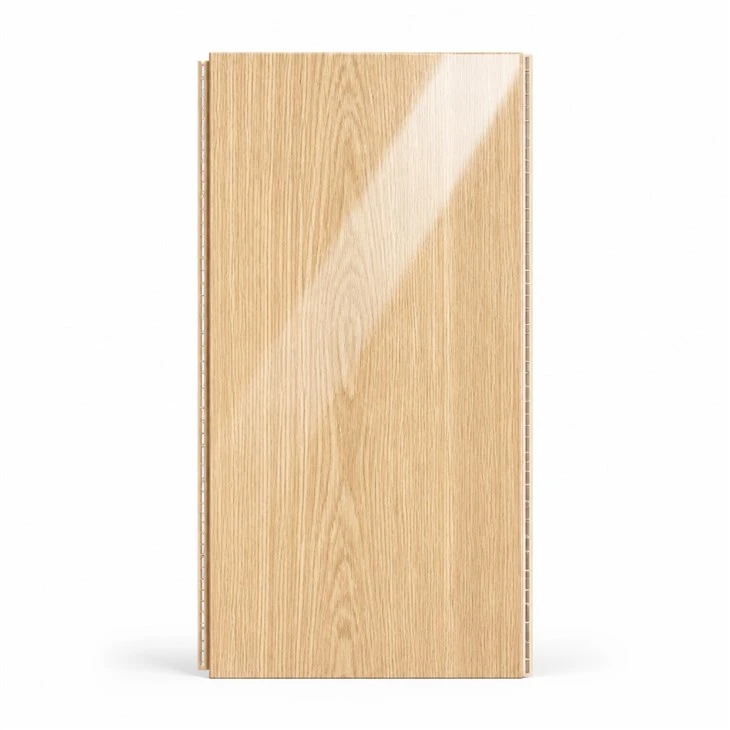


Wood-Grain PVC Wall Panels: Engineered Timber Look, Hollow Core Build
Wood-grain PVC wall panels give a project the look of natural timber without the moisture risk, the weight or the maintenance routine. Each panel is a hollow core profile with a laminated wood-grain film and a UV-cured topcoat, built for walls that need to stay clean and stay straight for years. They are specified by interior fit-out contractors, distributors and architects across the UK, EU, US, Australia and New Zealand, and supplied factory-direct from Eastopo.
The product family is simple to understand. A rigid PVC panel, shaped with parallel hollow channels inside, covered by a decorative wood-grain film and sealed with a hardened UV layer. Fitters call it a sheet job; buyers call it a repeatable specification. Both are right.
This page covers the structure, the finish, the factory data and the failure points a specifier actually needs before writing an order. If you are comparing pvc wood panel suppliers, the numbers below are the ones to check.
What "Hollow Core" Means in a PVC Wall Panel
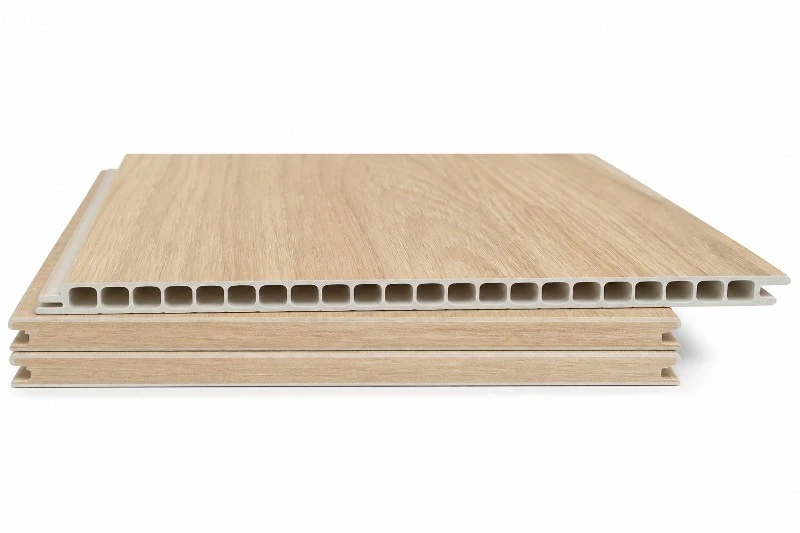
A hollow core PVC wall panel is an extruded profile with parallel rectangular channels running down its length, enclosed by solid PVC skins top and bottom. The channels make the panel lighter than a solid board while keeping enough rigidity for wall cladding. Thin ribs between the channels carry the load; the skins take the screw and the surface finish.
Two things matter in a hollow core build: channel geometry and skin thickness. Consistent rectangular channels mean uniform strength and predictable screw-holding. Thin, uneven walls mean telegraphing - the internal structure shows through the surface when the panel is fixed tight.
Our panels use a controlled PVC extrusion. The tongue-and-groove edges are profiled at the extrusion stage, so every sheet joins to the next with a positive mechanical lock.

Why Specifiers Choose Wood-Effect PVC Over Natural Timber
Natural timber looks good and behaves badly. It swells with humidity, cups when it dries, and needs sanding, sealing and re-finishing on a schedule. A wood-effect PVC panel removes the variable.
Moisture stability is the headline. The panel absorbs water at a rate of no more than 0.5% tested to EN 13245-2 Section 5.4, so kitchens, bathrooms, corridors and coastal regions are not a problem. Real wood in the same spots warps within a season.
Grain consistency is the second argument. Every panel in the batch carries the same film, so a 50-metre run of wall reads as one continuous surface. Timber grain varies board to board, and specifiers spend real time managing that variation on site.
Weight and handling come third. A hollow core sheet is light enough for one fitter to carry and cut on site, which keeps labour cost down on retrofit jobs where timber panelling would need two men and a scaffold of patience.
How the Wood Grain Finish Is Made: Film Lamination
The wood grain on Eastopo panels is not printed ink and it is not a transferred layer. It is a decorative PVC film, laminated onto the panel face during production, then sealed with a UV-cured topcoat at 2H pencil hardness or better.
Lamination gives the surface three practical advantages. First, the film is a continuous layer, so it resists scratching and edge wear better than a printed pattern. Second, the UV-cured topcoat blocks yellowing, which matters in sun-facing rooms and retail frontages. Third, the surface is non-porous, so grease, marker and grime wipe off with a damp cloth and no solvent.
For a distributor buying wood grain wall panels, the film type is worth asking about. Cheap boards use thin films that lift at the T&G edges or show roller marks. Ours are bonded and tested before the batch is released.
Technical Specification: Hollow Core Wood-Grain Panels
The table below is the specification Eastopo quotes for the wood-grain hollow core range. It is the same data we send with samples and the same data we print on the batch certificate. Whether you buy pvc wood panels by the container or by the project, this is the data sheet the factory works to.
| Parameter | Value | Note |
| Panel widths | 400 mm / 600 mm | Two stock widths, ready for dispatch |
| OEM widths | 400 mm / 600 mm | Same two widths on custom runs |
| Lengths | 2400 / 2700 / 3000 mm | Cut to order on request |
| Thickness | 8 mm / 9 mm | Two thicknesses; 9 mm for high-traffic walls |
| Weight | 3.5 - 4.2 kg/m² (8 mm); 4.0 - 4.5 kg/m² (9 mm) | Always quote weight with thickness |
| Surface | UV-cured topcoat ≥ 2H + wood-grain film lamination | Scratch and stain resistant |
| Water absorption | ≤ 0.5% (EN 13245-2 §5.4) | Suitable for wet areas |
| Fire classification | EN 13501-1 Class B-s2,d0 | Certified, certificate on request |
| Certification | CE EN 13245-2:2008 | Cert no. SC-PSC-4-2026-06-54 |
| Edge profile | Tongue and groove | Full-length joint, both edges |
Widths, Lengths and Thickness
The 400 mm panel width covers most wall and ceiling jobs - broad enough to cut the joint count across a wall while staying manageable for one fitter. The 600 mm width halves the seams again for feature walls and commercial cladding runs. Both panel widths are produced from one profile family, so a distributor can stock 400 mm and 600 mm without carrying multiple tooling lines.
Weight by Thickness
The 8 mm board runs at 3.5 - 4.2 kg/m² and is the default for standard walls. The 9 mm board runs at 4.0 - 4.5 kg/m² and is the right call for wall areas that see furniture traffic or need stronger screw-holding. Do not substitute one for the other without checking the fixing plan.
Surface and Environment
The laminated finish is built for humid rooms and high-traffic corridors alike. At 2H topcoat hardness the surface resists scuffs from trolleys and vacuum heads; the non-porous face rejects water, oil and most stains. The sealed PVC face and a simple wipe-clean routine keep surfaces hygienic in schools, clinics and office fit-outs.
What Goes Wrong When a Wood-Grain Panel Is Specified Wrong
Every failure mode in this section is one we have seen on real jobs. They are the reasons cheap pvc wood panel buys end up costing more than the timber they replaced.
High-fill boards fail at the screw. Boards loaded with calcium filler extrude cheap and hold screws badly - a shelf bracket pulls out within months, and every pull-out takes a chunk of skin with it. Our compound is a controlled PVC blend, and the 9 mm boards are specified where heavy items are mounted.
Thin skins telegraph. If the internal ribs press through the face, the wall shows a striped pattern in raking light. This shows up after fixing, not before, which makes it expensive to fix. The cure is skin thickness, and it is on the spec sheet - ask for it before you order, not after.
Mismatched T&G tolerances cause lipping. Panels from different batches with loose joints produce a stepped surface that no trim hides. That is why we recommend a single batch per project and why the MOQ structure is built around colour and finish, not mixed leftovers.
Skipping acclimatisation causes expansion trouble. Panels stacked in a cold warehouse and fitted in a warm room move once they reach equilibrium. Let the sheets stand in the room for 48 hours before fixing, and leave the recommended expansion gap at ends and corners.
Sourcing From a 36-Line Factory: OEM Widths, MOQ and Lead Times
Eastopo runs the wood-grain range out of its Haining facility, where 36 extrusion lines across the factory cover PVC wall and ceiling panels, acoustic panels and roofing membranes, with a combined monthly PVC panel capacity of 600,000-800,000 m². The full PVC wall panel range is listed on the category page. That capacity is what makes OEM work painless - a distributor's private-label colour can be scheduled without starving the stock lines. Buyers comparing pvc wood panel manufacturers get the same answer here: the numbers are published, and the certificate trail is attached to every batch.
Two Panel Widths
The two panel widths - 400 mm and 600 mm - are produced from one profile family, so a distributor can list both from one factory with one quality standard and one certificate trail. Panel lengths run to 2400, 2700 and 3000 mm on both widths.
MOQ and Lead Times
The MOQ is 500 m² per colour and finish. Stock colours leave in 18 - 22 days; custom films and private-label packaging run 28 - 35 days from confirmation. Sample cards and cut samples ship in a few days so the specification can be frozen before production starts.
Incoterms and Shipping
Eastopo quotes EXW, FOB, CFR or CIF. The factory team handles container loading, export documentation and batch certificates. For UK, EU, US, Australia and New Zealand buyers we ship from the same port programme used by our existing distributor network.

Installation: Tongue-and-Groove Joining
The T&G profile does most of the alignment work. Each sheet presents a tongue on one edge and a groove on the other; the next sheet slides in and the joint self-squares, which keeps verticals true on long runs.
Preparation
The substrate should be dry, flat and free of loose paint or plaster. On stud walls, mark the stud positions before fixing so every screw lands in timber or a fixing-grade anchor.
Fixing
Two methods are standard. Adhesive-only fixing suits smooth, clean substrates and light-use rooms; a construction adhesive on the back plus a nail or screw through the tongue at every third rib gives a mechanical lock that stays put. For televisions, mirrors and shelving, screw through the panel into the studs - the hollow core keeps the panel light, but the fixing must carry into the wall behind.
Trimming and Joints
Panels cut cleanly with a fine-tooth saw or a scoring knife. Cut edges on show should be capped with the matching trim profile; internal corners use the dedicated trim, and external corners get the aluminium or PVC angle section from the same range.

Where Wood-Grain Hollow Core Panels Work Best
Wood-effect panels earn their keep wherever timber looks right but behaves wrong. That list is longer than most buyers expect.
Residential feature walls are the obvious one - living rooms, bedrooms and stairwells get the warm grain without the veneer maintenance. Kitchens and bathrooms are the practical one: the 0.5% water absorption figure and the wipe-clean topcoat make them safe where real wood has no business.
Commercial interiors are the volume play. Office partitions, retail displays, hotel corridors and restaurant walls all need a finish that survives cleaning schedules and looks consistent under LED and daylight. Hospitality cubicles and wet-area partitions use the same panel with the same spec.
The point for distributors and contractors: one panel family, one certificate file, one set of fixing habits covers the residential, retail and hospitality sectors. That is the repeatable specification a buying team can stand behind.
Fire Rating and Compliance: What You Can Cite
Every claim on this page is backed by a test or a certificate we can send with the batch. For a B2B buyer, that is the difference between a supplier and a vendor.
Fire classification is EN 13501-1 Class B-s2,d0, which is the class referenced for interior wall and ceiling surfaces across the EU and UK. Water absorption, at ≤ 0.5%, is tested to EN 13245-2 Section 5.4 - the same standard behind the CE marking on this product line (CE EN 13245-2:2008, certificate SC-PSC-4-2026-06-54).
Certificate copies, test reports and the batch certificate are provided with every container.

Wood-Effect PVC vs. Real Wood: A Buying Decision Table
| Factor | Wood-effect PVC hollow core | Real timber panelling |
| Moisture stability | ≤ 0.5% absorption, no warp | Swells and cups with humidity |
| Grain consistency | Identical film across all sheets | Varies board to board |
| Weight per sheet | 3.5 - 4.5 kg/m² by thickness | Heavier, two-man handling |
| Maintenance | Wipe-clean, no sealing | Sand, seal, re-finish cycles |
| Fire class | EN 13501-1 B-s2,d0 | Varies by species and treatment |
| Indoor air & odour | Sealed PVC face, wipe-clean | Varies with coatings |
| OEM customisation | 2 widths, private label | Limited to available stock |
| Cost per installed m² | Lower, faster to fit | Higher material and labour |
The table is not a timber smear campaign - it is a risk register. Timber has its places, and we say so to customers who ask. But for walls that face water, carts, children or cleaning chemicals, the engineered panel is the lower-risk specification. For a pvc wood panel buyer comparing installed cost, this is the deciding row.
FAQ
1. What is the difference between a wood-effect PVC wall panel and real timber cladding? +
A wood-effect PVC panel is a hollow core profile with a laminated wood-grain film and a UV-cured topcoat. It keeps the timber look but removes the moisture risk: water absorption is ≤ 0.5% to EN 13245-2, so it will not swell or warp. It also weighs less, needs no sealing and wipes clean, which is why contractors specify it for bathrooms, kitchens and commercial corridors.
2. Is the wood grain finish printed or laminated? +
It is laminated. A decorative PVC film is bonded to the panel face during production and sealed with a UV-cured topcoat at 2H hardness or better. Lamination is more durable than printing: the film resists scratches and edge wear, and the topcoat blocks yellowing. This matters in sun-facing rooms and retail frontages where a printed surface would fade.
3. Are hollow core PVC wall panels waterproof enough for bathrooms? +
Yes for normal bathroom wall use. The panel absorbs no more than 0.5% water when tested to EN 13245-2 Section 5.4, and the non-porous surface rejects steam and splash. Seal joints and edges with the matching trim in showers and wet zones, and the installation will outlast painted or papered walls. For direct shower cubicles, use the dedicated wet-area fixing detail.
4. Do wood-grain PVC panels have a fire rating? +
Yes. The range is classified EN 13501-1 Class B-s2,d0, the class referenced for interior wall and ceiling surfaces in the EU and UK. The classification certificate is available on request and is included with the batch documentation. Fire classification is per panel and per film, so confirm the exact finish with our export team before finalising a specification.
5. What widths and lengths can I order for a commercial project? +
Panel widths are 400 mm and 600 mm with lengths of 2400, 2700 and 3000 mm. Thickness is 8 mm or 9 mm. A commercial project can therefore be specced from one factory with one certificate trail instead of mixing suppliers.
6. What is the MOQ and lead time for an OEM order? +
The MOQ is 500 m² per colour and finish. Stock colours ship in 18 - 22 days from order confirmation; custom films and private-label packaging run 28 - 35 days. Samples and colour cards ship within days so the specification can be frozen before production. Incoterms available: EXW, FOB, CFR or CIF.
7. Are the panels safe for indoor air quality? +
Yes. The sealed PVC face is quick to clean and rooms can be occupied immediately after installation, which is a practical advantage for schools, clinics and hotel refurbishments with tight handover dates.
8. How are the panels fixed - adhesive or screws? +
Both, depending on the wall. On smooth, clean substrates, construction adhesive alone works for light-use rooms. For a mechanical lock, screw or nail through the tongue at every third rib into the studs. Heavy items such as televisions or shelving must be screwed through the panel into the wall structure behind - never rely on the panel alone to carry the load.
9. Can I install wood-effect panels over existing tiles or painted walls? +
Yes, if the surface is dry, flat and sound. Tiles should be clean and grout lines filled; painted walls should have no loose or flaking paint. Use adhesive rated for the substrate and check flatness with a straightedge. Over uneven surfaces, fit a backing layer first - panels follow the wall, they do not fix it.
10. Do you supply to distributors and contractors outside China? +
Yes. Eastopo supplies distributors, contractors and interior fit-out companies worldwide, including the UK, EU, US, Australia and New Zealand. We quote EXW, FOB, CFR or CIF, handle container loading and export documentation, and provide batch certificates with every shipment. OEM and private-label programmes are available from 500 m² per colour and finish.
About the Author
Written by J. Mao - Eastopo New Materials
J. Mao is the Export Manager at Hangzhou Eastopo New Materials Technology Co., Ltd., where he has spent his career on PVC wall and ceiling panel exports to the UK, EU, US, Australia and New Zealand. He writes about hollow core panel construction, film lamination finishes and the factory data behind B2B wall panel specifications.
Questions on this page? Email mj@eastopo.com or WhatsApp +86 193 5725 8106.
Need a quote for a commercial project? Send your widths, lengths, finish and quantity - our export team replies within one working day with pricing, lead time and samples.
Hot Tags: pvc wood panel, wood effect wall panels, wood grain wall panels, hollow core pvc wall panel, pvc wall panel manufacturer, wood grain pvc wall panels, Bamboo Wall Panels Indoor, brick panels interior, interior decorative wall panels, Interior Decor Cladding Wood Grain, modern panelling, interior wall cladding for living room


