

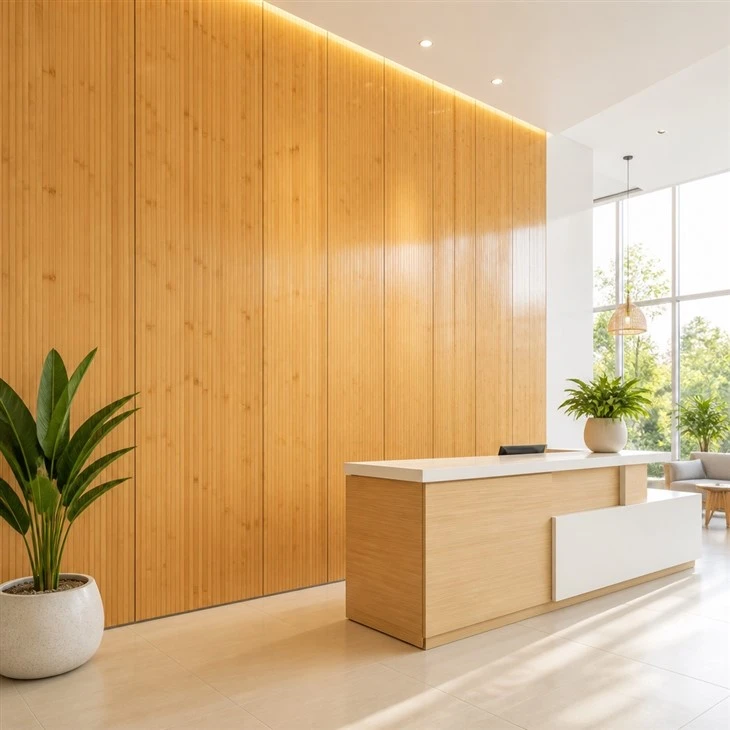


Bamboo wall panels indoor are one of those search phrases that promise more than the name says. A distributor searching it in the UK, US or Australia is usually after one thing: a bamboo-look wall finish that installs fast, stays identical across a project, and is priced for trade, not for a DIY shelf. This page explains what Eastopo actually supplies under that name, what the panel is built from, and what a wholesale buyer should check before placing a container order.
Bamboo Wall Panels Indoor: The Name and the Product
The honest starting point is that "bamboo wall panels indoor" is a market name, not a material description. The panel is PVC - extruded polyvinyl chloride - with a laminated bamboo-grain film on the face and a UV-cured topcoat on top of the film. There is no bamboo fibre inside the extrusion and no bamboo board behind the finish.
The name exists because that is what buyers type. Real bamboo panelling has a visual identity that is hard to argue with, and a bamboo-grain PVC panel delivers that look with none of the moisture behaviour of the natural product. For a fit-out contractor quoting fifty hotel bedrooms, the question is never "is it real bamboo" - it is whether the finish can be repeated across fifty rooms at a price the client accepts. That is the gap this product line fills. The full PVC wall panel range from the same extrusion base covers bathroom panels, ceiling panels and interior cladding.
What the Panel Actually Is: PVC Hollow Core With a Bamboo-Grain Finish
Strip away the marketing name and the build is simple and standard across the Eastopo range: two PVC skins with parallel rectangular hollow channels between them, a full-length tongue on one edge, a matching groove on the other, and a decorative film laminated to the face before the UV topcoat is cured.
The hollow core is the part that matters on site. It keeps a 400 mm-wide, 8 mm-thick sheet at 3.5–4.2 kg/m² (8 mm) or 4.0–4.5 kg/m² (9 mm), so one man can carry and position it without a lifting crew. The channels also remove the solid mass that would otherwise warp when humidity changes, which is the failure mode of natural timber in interior walls.
The finish is a decorative PVC film with a bamboo or wood-grain pattern, bonded during production and sealed with a UV-cured topcoat at 2H hardness or better. It is lamination, not printing on the board: the pattern sits inside the film layer and cannot be scratched off to reveal a blank core underneath.

Real Bamboo vs. Bamboo-Grain PVC: Why the Look, Not the Plant
Natural bamboo panelling has real strengths - it is a fast-growing material, it looks warm, and in dry interiors it can last for years. It also has three problems that show up on commercial projects: grain varies board to board, the material moves with humidity, and the supply chain for consistent grade is shorter than buyers expect.
A bamboo-grain PVC panel removes all three. The film is the same roll across the entire production run, so sheet 47 matches sheet 1. There is no moisture movement in the extrusion, which means no cupping at the joints in a bathroom or a kitchen. And the cost per installed square metre is lower because fitting is faster - no sanding, no sealing, no acclimatisation period on site.
That does not make the PVC version a replacement for every bamboo project. A designer specifying real bamboo for a feature wall where the client wants the actual material story will not be satisfied by a film. The PVC product wins where the brief is "bamboo look, repeatable, waterproof, on budget" - which is most of the trade demand.
Indoor Humidity, Moisture and the Hollow Core Edge
The rooms where real bamboo fails fastest are the rooms where indoor panels earn their keep: bathrooms, en-suites, kitchens, laundry rooms, hotel wet areas and the corridors that feed them. Natural bamboo absorbs water, expands, and cups or delaminates at the edges - usually within the first year in a shower-adjacent wall.
A bamboo-grain PVC panel is sealed by construction. The face is a laminated film under a UV topcoat, the core is closed-cell hollow channel PVC, and water absorption is 0.5% or less when tested to EN 13245-2 §5.4. Splashes, steam and condensation wipe off; they do not soak in. That is the difference between a wall that needs re-sheeting and a wall that is still flat at the five-year inspection.
One limit worth stating: PVC wall panels are not rated for saunas, steam rooms or surfaces in continuous contact with standing water. For those, specifiers use tile or dedicated wet-room systems. For normal indoor humidity - including bathrooms with extraction - the hollow core panel is a safe, documented choice.
Bamboo-Grain Panels in the Home: Living Room, Bedroom and Study
The same hollow core panel carries the bamboo finish into three rooms where interior panels get specified most. Each scene below is a full-height installation of the 400 mm and 600 mm panel widths with the bamboo-grain film and UV topcoat - one finish, repeated across the whole wall, no paint and no wallpaper seams.

Living room: a full-height feature wall behind a sofa, 8 mm panels with tongue-and-groove joints and wipe-clean maintenance. One person can carry and fit each sheet - no lifting crew, no sealing schedule.

Bedroom: the headboard wall finished in one run. Because the film is identical across every sheet, the wall reads as a single surface - the consistency real bamboo cannot guarantee board to board.

Home study: the same panels behind a desk give the room the timber look without the timber's humidity movement - no cupping at the joints when the heating season starts.
Technical Specification: Bamboo-Grain Hollow Core Panels
The specification below is the hollow core line data as quoted on every Eastopo trade page. Quote weight together with thickness - an 8 mm sheet and a 9 mm sheet are different products with different freight implications.
| Parameter | Value | Note |
| Panel widths | 400 mm / 600 mm | Two stock widths, ready for dispatch |
| OEM widths | 400 mm / 600 mm | Same two widths on custom runs |
| Lengths | 2400 / 2700 / 3000 mm | Cut to order on request |
| Thickness | 8 mm / 9 mm | Two thicknesses; 9 mm for high-traffic walls |
| Weight | 3.5 – 4.2 kg/m² (8 mm); 4.0 – 4.5 kg/m² (9 mm) | Always quote weight with thickness |
| Surface | UV-cured topcoat ≥ 2H + bamboo-grain film lamination | Scratch and stain resistant |
| Water absorption | ≤ 0.5% (EN 13245-2 §5.4) | Suitable for wet areas |
| Fire classification | EN 13501-1 Class B-s2,d0 | Certified, certificate on request |
| Certification | CE EN 13245-2:2008 | Cert no. SC-PSC-4-2026-06-54 |
| Edge profile | Tongue and groove | Full-length joint, both edges |
Tongue-and-Groove Fitting for Interior Walls
The bamboo-grain panels are a tongue-and-groove system: a full-length tongue on one edge slots into a full-length groove on the next sheet. The joint is what keeps a feature wall flat - every sheet is locked to its neighbour along the whole length, not just at fixing points.
On site the sequence is the same as any T&G PVC wall panel: fix battens or use a plasterboard background, start at a corner with the groove facing out, slide the next panel's tongue into it, and fix through the tongue lip so the next joint covers the screw. Cut with a fine-tooth blade or a sharp knife and score; the hollow core cuts cleanly without chipping. Leave a 3–5 mm expansion gap at top and bottom of a full-height run, then cover it with trim profiles.

What Goes Wrong When an Indoor Panel Is Chosen Wrong
Most indoor panel failures are specified in, not installed in. Three mistakes come up repeatedly on projects, and all three are avoidable at the ordering stage.
Wrong thickness for the span. An 8 mm panel fixed across wide batten spacing will bow between the supports; 9 mm is the safe default for vertical runs over wider spans. Match the thickness to the fixing pattern, not to the price list.
Film that was not UV-sealed. Cheaper panels laminate the decorative film and stop. Within 12–24 months of indoor light exposure the pattern yellows or fades unevenly. A UV-cured topcoat at 2H hardness is the difference between a wall that looks new at handover and one that needs re-sheeting.
High-fill recycled core that snaps in transit. Core quality is invisible in a sample photo and obvious in a crate. The risk profile changes with the extrusion recipe, which is why Eastopo runs controlled screened recycled PVC in a consistent mix rather than chasing the lowest input cost. Ask any factory for the CE documentation and a transit sample before committing to a container.
mboo\ Charcoal\ PVC\ Wall\ Panels:\ Same\ Line,\ Different\ Finish"Bamboo charcoal wall panel" is a term buyers in the UK and EU use for a specific look: the dark, carbonised finish of bamboo that has been heated and darkened, reproduced as a wood-grain film. It is not a charcoal-filled board, and it is not a different material - it is the same hollow core line with a darker bamboo-grain film. The charcoal finish carries its own specification sheet on the dedicated bamboo fibre carbon panel page.
The practical points for a buyer are the same as the light bamboo finish: identical spec table, identical MOQ, identical lead times. Order the two finishes in one container and they ship together, because both come off the same extrusion line and differ only in the film roll at the lamination stage.
Buying Bamboo PVC Wall Panels From a Factory: What to Verify
When the search term is "bamboo pvc wall panel", the results are dominated by wholesale listings - Alibaba and Made-in-China pages from Chinese extrusion factories. That is exactly the right channel to buy this product, but it pays to verify five things before a deposit:
1. Production depth. Eastopo runs 36 extrusion lines across the factory cover PVC wall and ceiling panels, acoustic panels and roofing membranes, with a combined monthly PVC panel capacity of 600,000–800,000 m². A factory with this scale keeps stock finishes ready for dispatch and holds the tooling for the two panel widths.
2. Certificates that match the product. Ask for the CE certificate number and check it against EN 13245-2:2008. Eastopo's number is SC-PSC-4-2026-06-54, and the fire classification EN 13501-1 Class B-s2,d0 is available on request.
3. A pre-shipment sample of the actual film. Photographs compress grain differences. A physical sample of the bamboo finish, the UV topcoat feel and the tongue profile is the only reliable check.
4. MOQ and lead time in writing. Expect 500 m² per colour and finish, with 18–22 days for stock finishes and 28–35 days for custom OEM runs. Anything quoting faster for a custom film is probably quoting on hope.
5. Incoterms you can cost. Eastopo quotes EXW, FOB, CFR and CIF only. That keeps the freight decision where it belongs - with the buyer's logistics team - and avoids the price surprises that come with delivered-duty terms.
MOQ, Lead Time, Incoterms and Export Packing
First orders run at a minimum of 500 m² per colour and finish - enough to hold tooling changeover costs where they belong while keeping the per-sheet price at factory level. Stock finishes dispatch in 18–22 days; custom OEM runs (your widths, your film, private label) take 28–35 days including film procurement.
Trade terms are EXW, FOB, CFR and CIF. Panels are bundled with edge protection, packed into cartons and palletised for container loading, with corner boards and straps on each pallet. A 20-foot container holds roughly 12,000–14,000 m² of 8 mm wall stock depending on widths; your freight forwarder gets a packing list and loading plan with the invoice.
Bamboo-Grain PVC vs. Real Bamboo vs. Timber vs. MDF: A Comparison Table
Four indoor wall materials, judged on the factors that decide a commercial fit-out. The table is deliberately short on adjectives and long on measurable differences.
| Factor | Bamboo-grain PVC hollow core | Real bamboo panelling | Timber cladding | MDF wall panels |
| Moisture stability | ≤ 0.5% absorption, no warp | Swells and cups with humidity | Swells, needs sealing | Swells at edges, not for wet areas |
| Grain consistency | Identical film across all sheets | Varies board to board | Varies by species | Consistent but flat print look |
| Weight per m² | 3.5 – 4.5 kg by thickness | Light to medium | Heavier, two-man handling | Heaviest option, sag risk on battens |
| Maintenance | Wipe-clean, no sealing | Oil and seal cycles | Sand, seal, re-finish | Wipe-clean, edge swelling risk |
| Fire class | EN 13501-1 B-s2,d0 | Varies by treatment | Varies by species | Varies by density and coating |
| Installation | T&G clip-on, fast | Specialist fitting | Framing and finishing | Screw and joint fill, slow |
| Cost per installed m² | Lower, faster to fit | Higher material cost | Higher material and labour | Low material, higher labour |
FAQ
1. Are bamboo wall panels indoor made from real bamboo? +
No. They are PVC hollow core panels with a laminated bamboo-grain film on the face and a UV-cured topcoat. The bamboo look is a film finish, not a bamboo board, which is what makes the panels consistent, waterproof and fast to install across a whole project.
2. Does a bamboo pvc wall panel contain bamboo fiber? +
No. The panel is extruded PVC with parallel rectangular hollow channels between two skins. Bamboo pvc wall panel is the market term buyers use for the bamboo-look finish; it does not describe the material composition. The structure is hollow core, not bamboo composite.
3. What is a bamboo charcoal PVC wall panel? +
It is the same hollow core line with a darker, carbonised bamboo-grain film. The term describes the dark wood-grain finish, not a charcoal-filled board. Specs, MOQ and lead times are identical to the light bamboo finish, and both finishes can ship in one container.
4. Can bamboo-grain PVC panels be used in bathrooms and kitchens? +
Yes. Water absorption is 0.5% or less tested to EN 13245-2 §5.4, and the laminated film plus UV topcoat seals the face. They handle splashes, steam and condensation. They are not rated for saunas, steam rooms or continuous standing water, where tile or dedicated wet-room systems apply.
5. How are bamboo wall panels indoor installed? +
Panels use a full-length tongue-and-groove joint. Fix battens or use a plasterboard background, start at a corner with the groove out, slide the next tongue in and fix through the tongue lip. Cut with a fine-tooth blade or score and snap. Leave a 3 to 5 mm expansion gap top and bottom and cover with trim.
6. What is the wholesale price of bamboo pvc wall panels? +
Factory pricing depends on thickness, width, finish and quantity, with a 500 m² minimum per colour and finish. Send widths, lengths, finish and quantity to the export team and you get an itemised quote within one working day, including weight-based freight estimates.
7. How long do bamboo-grain PVC panels last indoors? +
The hollow core structure does not warp or cup with indoor humidity, and the UV-cured topcoat protects the film from yellowing. With wipe-clean maintenance, panels retain their appearance through years of service in normal indoor environments, including bathrooms with extraction.
8. What sizes and thicknesses are available for indoor bamboo panels? +
Panel widths are 400 mm and 600 mm, lengths are 2400, 2700 and 3000 mm, and thickness is 8 mm or 9 mm. Weights range from 3.5 to 4.5 kg per m² depending on thickness.
9. What is the MOQ and lead time for bamboo pvc wall panel orders? +
MOQ is 500 m² per colour and finish. Stock finishes dispatch in 18 to 22 days; custom OEM runs take 28 to 35 days. Trade terms are EXW, FOB, CFR and CIF. A 20-foot container carries roughly 12,000 to 14,000 m² of 8 mm wall stock depending on widths.
10. How does a bamboo-grain PVC panel compare with real bamboo panelling? +
Real bamboo offers the natural material story but varies board to board, moves with humidity and needs specialist fitting. The PVC version delivers the same visual direction with an identical film on every sheet, no moisture movement and a lower installed cost. Choose real bamboo where the material itself is the brief; choose PVC where repeatability, waterproofing and budget decide.
About the Author
Written by J. Mao - Eastopo New Materials
J. Mao is the Export Manager at Hangzhou Eastopo New Materials Technology Co., Ltd., where he has spent his career on PVC wall and ceiling panel exports to the UK, EU, US, Australia and New Zealand. He writes about hollow core panel construction, film lamination finishes and the factory data behind B2B wall panel specifications.
Questions on this page? Email mj@eastopo.com or WhatsApp +86 193 5725 8106.
Need a quote for a commercial project? Send your widths, lengths, finish and quantity - our export team replies within one working day with pricing, lead time and samples.
Hot Tags: bamboo wall panels indoor,bamboo pvc wall panel,bamboo charcoal pvc wall panel,bamboo effect wall panels,hollow core pvc wall panel,tongue and groove bamboo panels, Bamboo Wall Panels Indoor, brick panels interior, interior decorative wall panels, Interior Decor Cladding Wood Grain, modern panelling, interior wall cladding for living room


