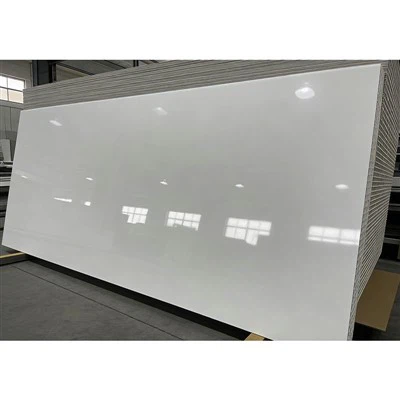



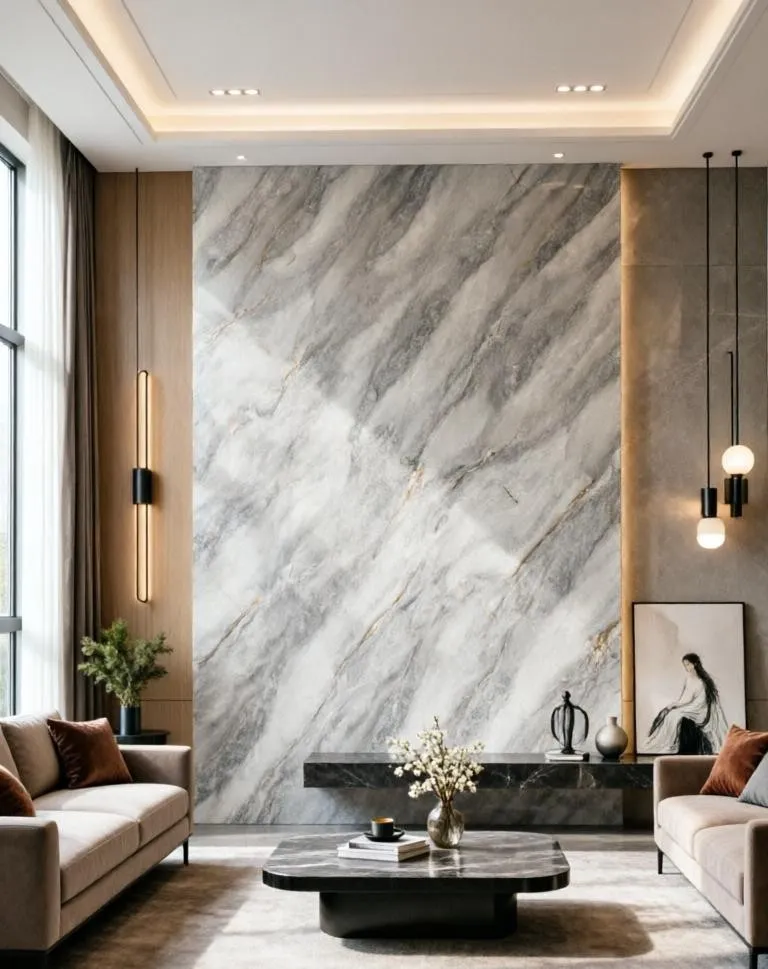


Factory-direct PVC wall panels for interior residential and commercial spaces - not just for bathrooms. 1000 mm wide hollow-core PVC sheet with machined tongue-and-groove interlocking joint, low VOC calcium-zinc formulation, 500+ decorative finishes. CE EN 13245-2 certified, MOQ 500 sqm per finish.
Get an interior-wall quote in 24h → mj@eastopo.com · WhatsApp +86 193 5725 8106
On this page
- What are PVC wall panels for interior use?
- Not just for bathrooms - PVC wall panels in living rooms, bedrooms & commercial spaces
- Indoor air quality - low VOC, formaldehyde-free PVC formulation
- PVC wall panel vs WPC wall panel - which interior material is right?
- Panel specifications
- 500+ decorative interior finishes: 3D, wood grain, marble, solid colour
- Residential vs commercial - choosing the right panel specification
- Installation - interlocking seam system, DIY friendly
- Trade buyer information
- Frequently asked questions
What are PVC wall panels for interior use?
A PVC wall panel is a rigid extruded polyvinyl chloride sheet designed to cover interior walls as an alternative to paint, wallpaper, drywall finishing, or ceramic tile. The panel has a hollow core structure for weight reduction and thermal insulation, a decorative face film sealed with a UV-cured 2H+ topcoat, and machined tongue-and-groove edges that lock adjacent panels together without exposed fasteners or sealant lines.
Interior PVC wall panels have three use categories that account for most trade-buyer orders:
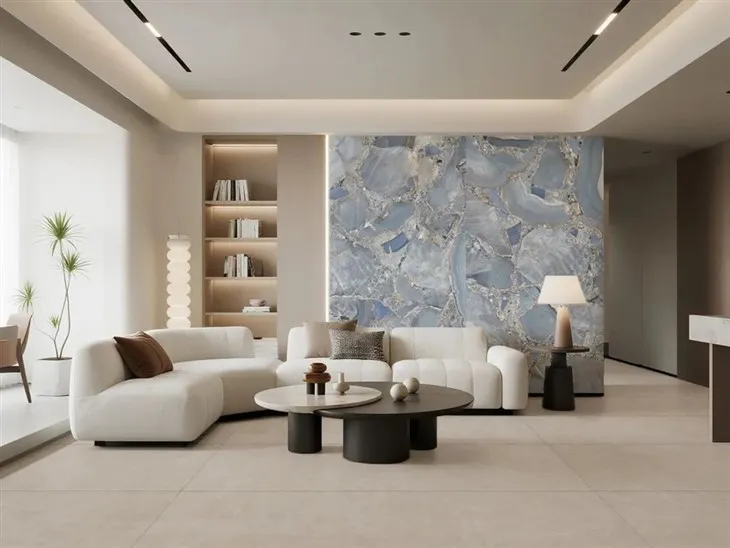
- Decorative feature walls - 3D textured panels, wood-grain planks, and marble-effect sheets used as an accent wall in living rooms, bedrooms, hotel lobbies, and retail spaces. The panel replaces the labour cost of skim-coating drywall or hanging wallpaper, and the interlocking joint produces a continuous surface with no visible seams.
- Full-room wall cladding - Used in place of paint or drywall finishing in rental apartments, student accommodation, and budget hotel rooms where the specifier wants a cleanable, impact-resistant wall surface with a consistent decorative finish across all four walls.
- Dry-zone commercial wall covering - Office partition walls, retail fitting rooms, restaurant dining areas, and corridor wall protection. Not a wet-zone application (that is the bathroom/wet-wall product category), but a durable, wipeable surface for high-traffic dry areas.
Not just for bathrooms - PVC wall panels in living rooms, bedrooms & commercial spaces

Six interior spaces where PVC wall panels are specified outside the bathroom. Roughly 40% of interior PVC panel orders are for non-bathroom applications.
The default mental image for a PVC wall panel in the building trade is a white bathroom cladding sheet. That image misses roughly half the addressable market for interior PVC panels. Here is what interior designers and commercial specifiers use PVC panels for outside the bathroom:
| Space | Typical PVC panel application | Popular finish |
|---|---|---|
| Living room / bedroom accent wall | Full-height feature wall behind the bed headboard or TV unit | 3D wave / fluted / wood-grain plank |
| Hotel lobby / reception | Reception desk backdrop wall, elevator lobby panels | Marble-effect, brushed metal |
| Retail fitting rooms | Wall-to-wall cladding for cleanability and uniform brand colour | Solid RAL matched colour, matte |
| Office partition / meeting rooms | Half-height wall panel as decorative partition surface | Wood grain, concrete-effect |
| Restaurant dining area | Wainscoting-height wall protection with wipe-clean surface | Stone-effect, terrazzo |
| Corridor / hallway wall protection | Chair-rail to skirting panel for impact and scuff resistance | Solid colour, micro-texture anti-scuff |
Why specifiers choose PVC over paint for these applications: paint needs repainting every 3-5 years in high-traffic commercial corridors. PVC wipes clean with a single pass of a microfibre cloth and neutral detergent. Installed cost of PVC over painted drywall is higher at initial fit-out (roughly $8-15 per sqm panel cost vs $2-4 per sqm for paint and labour), but the 15-20 year service life versus a 3-5 year repaint cycle recovers the cost within two maintenance cycles.
Indoor air quality - low VOC, formaldehyde-free PVC formulation

Three indoor air quality test results: EN 717-1 E0 formaldehyde, ISO 16000-6 zero VOC, REACH SVHC / Prop 65 compliant stabiliser formulation.
Interior PVC panels live in occupied spaces - bedrooms, living rooms, offices - where the air quality standard is higher than for a bathroom or external cladding. Three test results matter for indoor specification:
| Test | Standard | Result | What it means for indoor use |
|---|---|---|---|
| Formaldehyde emission | EN 717-1 | Below detection limit (E0, less than 0.1 ppm) | Panel can be installed and the room occupied on the same day. No off-gassing delay. |
| VOC (volatile organic compounds) | ISO 16000-6 | Not detected at 23 °C ambient | No detectable VOC release at room temperature. No "new panel smell." |
| Stabiliser formulation | REACH SVHC | Calcium-zinc eco-stabilisers. No lead, no cadmium, no restricted phthalates. | California Proposition 65 compliant. Safe for residential and educational indoor use. |
Why this matters for trade buyers: A housing association specifying 100 bathrooms and 100 living-room accent walls in the same building needs to answer the tenant question "does the panel off-gas?" in both rooms. Our test data lets the specifier answer with a single data sheet - the formulation is the same, the test results are the same, and the panel is indoor-air-quality-grade regardless of which room it goes into.
PVC wall panel vs WPC wall panel - which interior material is right?

PVC vs WPC head-to-head across 8 attributes. PVC wins for volume fit-outs and low-VOC specifications.
Wood-fibre WPC (wood-plastic composite) is the most commonly cross-searched alternative to PVC in the interior wall panel category. Those wood-fibre WPC panels contain wood fibre blended with PVC or PE polymer, giving them a marginally more natural-feeling surface texture. For interior dry-zone applications, the honest comparison is:
| Attribute | PVC (ours) | Wood-fibre WPC |
|---|---|---|
| Core material | 100% virgin PVC, hollow core | PVC/PE + wood fibre blend, foam or solid core |
| Weight per sqm | 3.5-4.5 kg (lighter, easier to install) | 5-8 kg |
| Water absorption (EN 13245-2 (Section 5.4), 24h submerged) | Less than 0.5% (functionally non-porous) | 0.5-2% (wood fibre absorbs trace moisture in high-humidity rooms) |
| Formaldehyde emission | Below detection limit (E0) | May contain trace formaldehyde from the wood fibre component (E1 typical) |
| Surface hardness | 2H+ UV-cured topcoat | Variable (depends on surface film, typically 1H-2H) |
| FOB cost per sqm | $8-15 | $12-22 |
| Recyclability | Fully recyclable (single-polymer PVC with no mixed-material bonding) | Difficult to recycle (wood fibre bonded to polymer cannot be separated) |
| Best for | Volume interior fit-outs where low VOC, light weight and recyclability matter | High-end single-room residential where a marginally more natural-feeling surface texture is the specifier's priority |
Recommendation for interior dry zones: PVC wins for volume fit-outs and for any project with a low-VOC specification requirement. WPC has a marginally nicer hand-feel for a single luxury residential room but costs roughly 50% more per sqm at FOB and is heavier to ship.
Panel specifications
| Material | 100% virgin PVC extrusion with hollow core |
| Panel width | 1000 mm (39.4 in) standard · 250 mm and 375 mm on request |
| Panel length | 2400 / 2700 / 3000 mm |
| Thickness | 10 mm (0.39 in) |
| Weight per sqm | 3.5-4.5 kg (0.7-0.9 lb per sqft) |
| Water absorption 24h | ≤ 0.5% (EN 13245-2 (Section 5.4)) |
| Fire performance (EN 13501-1) | Class B-s2, d0 (equivalent to ASTM E84 Class B flame spread, smoke index under 450) |
| Surface hardness | ≥ 2H pencil (UV-cured topcoat) |
| Formaldehyde emission (EN 717-1) | E0 (below detection limit, less than 0.1 ppm) |
| Joint system | Machined tongue-and-groove interlocking, 0.2 mm tolerance |
| Finish options | 500+ - 3D wave, wood grain, marble, concrete, metal, solid colour |
| Warranty | 15 years commercial (structure) · 5 years (UV colour-fastness) |
500+ decorative interior finishes: 3D, wood grain, marble, solid colour
| Category | Popular interior finishes | Recommended interior application |
|---|---|---|
| 3D / Textured | Wave, fluted, ribbed, diamond geometric | Living room feature wall, hotel lobby, retail display backdrop |
| Wood grain | Walnut, Oak, Ash, Teak, herringbone parquet | Bedroom accent wall, office meeting room, restaurant dining area |
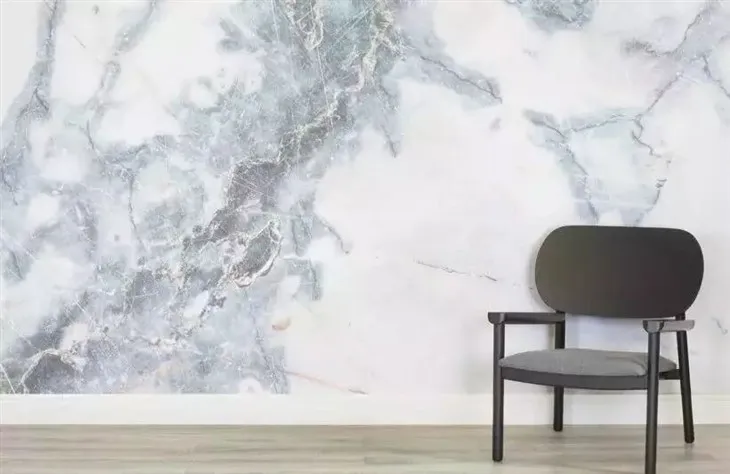
| Marble | Calacatta, Carrara, Statuario, Emperador | Hotel reception, executive office, luxury retail fitting room |
| Concrete & stone | Micro-cement grey, terrazzo, slate, sandstone | Industrial-loft living room, commercial corridor, retail |
| Metal effect | Brushed steel, bronze, copper, gunmetal | Office partition, restaurant wainscoting, bar area |
| Solid colour | Gloss white, matte black, RAL / NCS custom | Healthcare corridor, education, rental apartment uniform finish |
Custom-print colour matching at Delta-E ≤ 1.5 versus Pantone reference. Custom-print minimum: 1000 sqm per finish, tooling amortised over 3 orders.
Residential vs commercial - choosing the right panel specification

Same 10mm panel, different specification sheet. Residential vs commercial project specification priorities.
Residential and commercial interior projects have different specification priorities. The same 10 mm PVC panel is used for both, but the specification sheet you give the client differs:
| Specification item | Residential (apartment, house, single room) | Commercial (hotel, office, retail, education) |
|---|---|---|
| Finish priority | Design aesthetic, colour match to furniture | Durability, cleanability, fire rating |
| Fire rating requirement | EN 13501-1 B-s2, d0 (standard, meets residential code) | Same B-s2,d0 - confirm with building control officer for notifiable protected areas |
| VOC / indoor air quality | E0 formaldehyde (below detection). Panel installed and occupied same day. | Same E0 + full material safety data sheet for submittal to client's health & safety file |
| Impact resistance | Standard 10 mm hollow core adequate for furniture bumps | 10 mm standard; specify solid-core if wall faces trolley/cart traffic (hotel corridor) |
| Install volume | 20-60 sqm per project (single home remodel) | 500-5,000+ sqm per project (hotel floor, school block, office floor plate) |
| Recommended MOQ | 500 sqm per finish (buy through merchant stockholder if project is smaller) | 500 sqm per finish, tier pricing activates at 2,000 and 5,000+ sqm |
Installation - interlocking seam system, DIY friendly
Install time for a standard 12 sqm living-room feature wall (3m x 4m): 3-4 hours for two fitters or approximately 6-8 hours for a competent DIY renovator working alone. The interlocking tongue-and-groove system means no visible fasteners, no sealant lines between panels, and no grout.
Step 1 - Prep the substrate
Wall must be dry, flat within 3 mm across 2 m, and free of dust or loose paint. The substrate can be painted drywall, plaster, or existing wallpaper that is firmly bonded (no peeling edges). Unlike bathroom installation, no tanking or waterproofing membrane is needed for dry-zone interior walls.
Step 2 - Measure and cut
Score with a utility knife along a straight edge, then snap along the score line. Fine-tooth jigsaw for outlet cut-outs. Allow 3-5 mm expansion gap at floor and ceiling - matching trim or skirting covers it.
Step 3 - Apply adhesive
Solvent-free MS polymer adhesive, 6 mm zigzag bead around panel perimeter plus three vertical beads down the middle. Coverage: one 290 ml cartridge per 2.4 sqm. For temporary installations (rental apartments, trade-show booths), mechanical fastening at the trim line is an alternative to adhesive bonding.
Step 4 - Lock the interlocking joint
Start from a corner. Press the next panel's tongue into the fixed panel's groove at a 20-degree angle, then rotate flat. The interlocking joint closes with a firm hand-push. No hammer, no nails, no visible fasteners. The continuous surface has no seam line - the decorative film pattern continues uninterrupted across the joint.
Step 5 - Finish with trim or skirting
Use matching PVC trim at external corners and ceiling-to-wall junctions. Floor-level joint is typically covered by the existing skirting board. For feature walls where the panel ends mid-wall, use a matching end-cap trim or a decorative aluminium profile.
Trade buyer information

Container loading, Incoterms, lead time, free samples, full material safety data sheet with every order.
| MOQ | 500 sqm per colour / finish |
| Container loading | 20ft: 1,800-2,200 sqm · 40ft HC: 4,800-5,400 sqm |
| Lead time | 18-22 days ex-Ningbo for stock finishes · 28-35 days for custom digital-print |
| Incoterms | EXW / FOB / CFR / CIF |
| Samples | Standard finish sample cards free · custom-print samples USD 40, freight collect |
Trade benefits
- Tier pricing at 500 / 2,000 / 5,000+ sqm, quoted per RFQ
- OEM back-print free from 3,000 sqm - your brand name, batch code
- Dedicated account manager - one contact from quote to loading photos
- Full material safety data sheet for commercial submittals (VOC, formaldehyde, fire rating)
Frequently asked questions
Can PVC wall panels be installed in a living room or bedroom, or are they only for bathrooms? +
They can be installed in any interior dry zone. The most common non-bathroom applications from our trade buyers are living-room feature walls (3D or wood-grain panels behind the TV unit or bed headboard), hotel lobby and reception backdrops, office meeting-room walls, retail fitting rooms, and restaurant wainscoting. The panel formulation and fire rating are the same regardless of room - what changes is the decorative finish. Our buyers order roughly 40 percent of interior PVC panels for non-bathroom applications.
Are PVC wall panels safe for indoor air quality? Do they off-gas? +
Our calcium-zinc PVC formulation tests below the EN 717-1 formaldehyde detection limit (E0, less than 0.1 ppm) and shows no detectable VOC release at 23 °C ambient under ISO 16000-6. The panel contains no lead, no cadmium, and no restricted phthalates (REACH SVHC and California Proposition 65 compliant). You can install the panel and occupy the room on the same day.
What is the difference between wood-fibre WPC and PVC wall panels for interior use? +
PVC is a 100 percent virgin polymer hollow-core panel; wood-fibre WPC blends PVC or PE with wood fibre. For interior dry-zone walls, PVC is lighter (3.5-4.5 kg/sqm vs 5-8 kg/sqm), has lower water absorption (0.02-0.04 percent vs 0.5-2 percent for WPC), costs less at FOB ($8-15/sqm vs $12-22/sqm), is fully recyclable as a single-polymer product, and tests at E0 formaldehyde. WPC gives a more natural hand-feel but typically tests at E1 formaldehyde.
How does the interlocking seam system work, and does it show visible joints? +
Each panel has a tongue machined on one long edge and a groove on the opposite edge, both profiled to a 0.2 mm tolerance. When two panels are joined, the tongue locks into the groove and the decorative film continues uninterrupted across the joint line. Under normal interior lighting at a viewing distance of 1.5 m, the joint is not visible. The interlock uses no silicone, grout, or mechanical fasteners on the panel face.
What is the minimum order quantity for a single-room residential project? +
Our MOQ is 500 sqm per finish, which typically exceeds a single residential room (a standard 3m x 4m feature wall is roughly 12 sqm). For single-room orders, we recommend buying through a UK, EU, or US-based merchant stockholder who breaks container quantities into room-sized packs. Email us your location and panel count and we can introduce you to a local distributor.
Can I use the same PVC panel specification for a residential living room and a commercial hotel corridor? +
Yes. The 10 mm hollow-core panel is the same product for both applications. What differs is the data you submit. A residential project needs the VOC and formaldehyde test data for tenant assurance. A commercial project also needs the fire rating (EN 13501-1 Class B-s2, d0) and the full material safety data sheet for the client's health and safety file. Tell us your project type and we include the correct certification set with every order.
About the Author
Written by J. Mao - Export Manager, Eastopo New Materials. J. Mao leads export specification for Eastopo's PVC wall and ceiling panel lines, working with distributors, hotel groups and housing associations across the UK, EU, US and Australia on bathroom and interior fit-outs. Questions on this page: mj@eastopo.com or WhatsApp +86 193 5725 8106.
Ready to specify PVC interior wall panels?
Tell us your project type - residential or commercial - and preferred finish. We reply within 24 hours with a specification data sheet, container-fit calculation, and sample recommendation.
Email mj@eastopo.com · WhatsApp +86 193 5725 8106 · Hangzhou Eastopo New Materials Technology Co., Ltd.
Related: All PVC Bathroom Cladding Panels · Waterproof Bathroom Wall Panels · PVC Bath Panel · White PVC Panel Bathroom
Hot Tags: pvc wall panels interior, interior wall panels, pvc interior wall panels, decorative pvc panels, wood effect wall panels, internal cladding sheets, PVC Bathroom Cladding Panel, White Marble PVC Wall Panel, Deco Wall Panel, PVC Panel For Bathroom Ceiling, Interlocking PVC Wall Panel